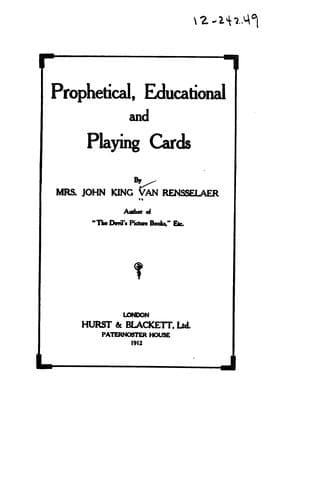
Prophetical, Educational and Playing CardsVan Rensselaer, John King, Mrs.
Religion
Prophetical, Educational and Playing Cards
Van Rensselaer, John King, Mrs.
Fortune-telling by cards -- History; Playing cards -- History
The Coppas or Cup suit is appropriately typified by a Cup or Chalice or
the Vase of Mercury Chthonius. This device is superseded by the Hearts of
the French pack, which symbolise the passive principle of the universe.
Corresponding as it does with the chalice of the clergy, it betokens not
only men of religious life, but those of knowledge and power through
learning, and also scientific men and those in the government and law.
Love and instruction are typified by the symbolic Cup that denotes fair
people, who are also represented by the suit of Denari when the cards are
consulted about the affairs of life.
The Cup plays a prominent part in the symbolism of ancient days. In
"Records of the Past," by Professor Sayce (Vol. III, page 86), is a letter
from Dusratta to Amenophis III, translated from a cuneiform tablet
discovered at Tel-el-Amarun, in Upper Egypt:
"And to my father did thou send much gold,
An oblation dish of solid gold and a Cup of solid gold,"
showing that the Cup symbolised not only a connection with sacrifice, but
was also a bond of friendship. Votive cups are found in the temple of
Osiris, showing that they were used in his worship. Some are very small,
as if intended for children to use.
The "Cupbearer" to Royalties in Babylonia and Egypt was a most important
post, for the person was chosen for faithfulness, since poison could be so
easily conveyed in wine and drunk unsuspectingly by the king. The
"Sakibearer" or Butler of Persia became one of the heroes or gods. He was
also called "the Spiritual Instructor," showing a connection with the
priesthood, or "He who hands a Cup of Celestial Love," which is typified
by the wine as well as the Cup. "Jamshid, one of the greatest rulers of
Iran" (Persia), says Major Sykes, in "The Glory of the Shia World" (page
139), "was able by means of his seven-ringed Cup not only to predict the
future, but also survey the entire world." This Jamshid had many of the
qualities of Thoth Hermes attributed to him, for he introduced into his
country the use of iron, the arts of weaving, wine-making, and healing,
with many other arts and sciences, his memory is greatly revered. Omar
Khayyam sings of him
"Iran, indeed, is gone with all his Rose
And Jamshid's sev'n ring'd Cup,
Where? No one knows."
Public-domain text, read in full here on John Shaqi.
Reviews
Reviews
No reviews yet
Be the first to share your thoughts on this work.
Elsewhere in the archive
Join the Discussion
Join the discussion
Sign in to leave a comment or review.
Sign InorCreate an account