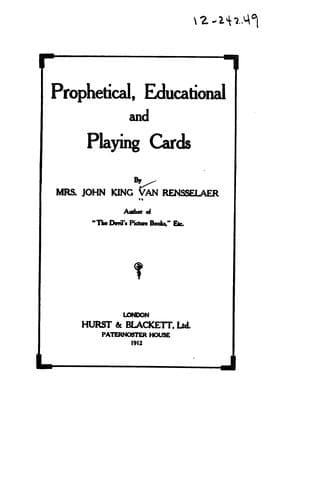
Prophetical, Educational and Playing CardsVan Rensselaer, John King, Mrs.
Religion
Prophetical, Educational and Playing Cards
Van Rensselaer, John King, Mrs.
Fortune-telling by cards -- History; Playing cards -- History
As in Biblical times the rods were called after the men who used them as
representing the ruler of their families, so substituting their pictures
was probably the next step. The cards then were numbered up to ten, while
the father, mother, child, and servant were represented in what we name
Court cards. This enabled a man to ask queries of the gods in a most
particular way. Should he be a soldier he would select a Sword emblem to
typify him and his family, and then, laying the cards of that suit before
the testimony (which signifies the tables of stone or the commandments),
he awaited the answer that was conveyed to him after the priest had
consulted the cards with reference to the way they were dealt in
connection with the pictures on the walls.
In Chinese fortune-telling the gamblers resort to a "shrine of the god of
war," says Mr. Culin, in "Korean Games" (page 23), "and throw numbered
arrows or sticks to divine the wishes of the gods, while sometimes paper
lots are employed." The arrows are kept in a tube like a quiver, or
dicebox, and shaken out at random. The shrine is finely decorated,
containing mystic figures and devices, and it stands upright against a
wall. A table on which to shake the arrows is placed before the shrine. On
page 26 of "Korean Games," Mr. Culin states: "In Japan fifty slender,
rounded splints of bamboo, called Zeichiku, varying in length from two to
fourteen inches, are used. The fortune-teller gathers them in his right
hand, raising it reverently to his forehead, muttering incantations, then
parts the sticks into bundles, prophesying good or evil according to the
number in each, and it is said that each splint, having its value and
meaning, covers all events of a man's life as recorded in a book of
'oracular responses' that the diviner keeps beside him for reference."
Mr. Culin also mentions the "Meisir game of the Arabs," when seven arrows
were shaken from a tube or quiver. This old game was played before the
time of Christ, and Mahomet prohibited it, calling it "the work of
devils." Arrows made of nab-a tree were used. (This name was seemingly
derived from Naib or prophet.) They were of a bright yellow colour, and
when shaken in the box gave a peculiar ringing sound, so arrows made of
any other wood were considered undesirable and were discarded. Each arrow
had a name and was marked with a numeral.
The significant and historical Staff or Rod of the Tarots was replaced in
the French pack by the design of a clover leaf, or, as it is called,
_Trèfle_, which we name a Club, a cognomen that recalls the original
intention, so would otherwise be meaningless. Nor does the Coin or the
Denari take the place of the one that originally represented Mercury
Agoneus, the protector of merchants and of commerce. This sign when
consulting the oracle denotes fair people and also the element of water,
and anything floating on it or living in it, besides all things connected
with trade, mercantile transactions, or development.
Public-domain text, read in full here on John Shaqi.
Reviews
Reviews
No reviews yet
Be the first to share your thoughts on this work.
Elsewhere in the archive
Join the Discussion
Join the discussion
Sign in to leave a comment or review.
Sign InorCreate an account