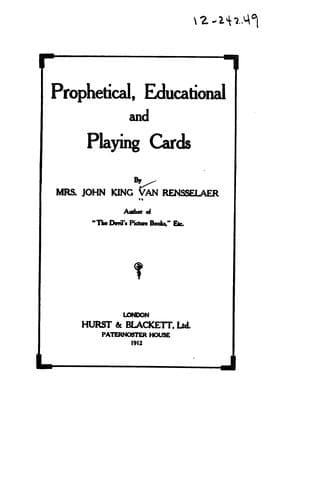
Prophetical, Educational and Playing CardsVan Rensselaer, John King, Mrs.
Religion
Prophetical, Educational and Playing Cards
Van Rensselaer, John King, Mrs.
Fortune-telling by cards -- History; Playing cards -- History
There is only one spot in the world where these cards remain in their
pristine condition and are played with to-day, and where they are offered
for sale, and it is interesting to note that it is close to the place
where the worship of Thoth first made its appearance in Europe.
The Tarots are now used for playing several games, and these, if analysed,
will show marks of the ancient mysteries. Through them can be traced not
only a birthplace, but a history declared by de Gebelin to hark back to
the borderland of civilization. He points out that the writers of his day
have confined their studies to French cards used in Paris, when they were
looking for the origin of playing cards, entirely ignoring, or at least
never referring to, the Tarots, of which probably they had never heard.
The history of French cards was not hard to relate, since it goes back
little over three hundred years. There is a record of their birth, and, as
has been mentioned, there are survivors of the original pack now to be
seen in Les Cabinet des Estampes in Paris, which display Hearts, Diamonds,
Clubs, and Spades.
Merlin, Chatto, Singer, and Breitkopf look farther afield than de
Gebelin's predecessors, whose writings are now forgotten, but all of them,
while acknowledging that the images or the pips of the Tarots with which
they are familiar have some connection with an old condition of affairs,
fail to trace it, since no reliable historical or legal record of cards
that are called "Playing Cards" can be discovered prior to the Middle
Ages, so they assumed that cards could not have existed before that date,
but the possibility that they might have lived and flourished under
another name is overlooked.
These authorities acknowledge that the shape, the sequence, and the
grouping of the Tarots display system, which they decide is interesting
but incomprehensible, yet they fail to unravel the significance of these
arrangements. They touch upon the strange resemblance of various figures
and their value in the game of _L'Ombre_ (The Man) to the civil law,
philosophy, and religion of the ancient Romans, Greeks, or Egyptians. Mr.
Singer points to one of the Atouts that he says "resembles the attributes
of Osiris," and other cards impress him as recalling those of Mercury, as
well as other mythological personages that he writes "seem to be found
among the Atouts." But all the authors arrest themselves at this point
without inquiring if these ancient gods whom they recognised were placed
with intention or by chance on the cards, and, although they concede that
the cards were used for divining purposes, they fail to connect them
distinctly with the mysteries of past ages.
Public-domain text, read in full here on John Shaqi.
Reviews
Reviews
No reviews yet
Be the first to share your thoughts on this work.
Elsewhere in the archive
Join the Discussion
Join the discussion
Sign in to leave a comment or review.
Sign InorCreate an account