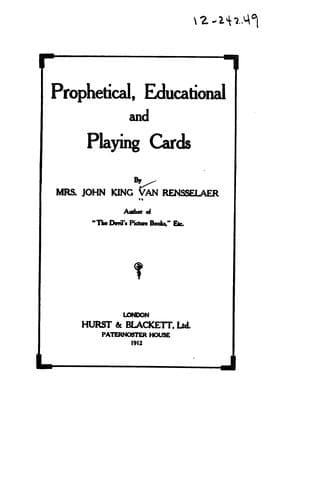
Prophetical, Educational and Playing CardsVan Rensselaer, John King, Mrs.
Religion
Prophetical, Educational and Playing Cards
Van Rensselaer, John King, Mrs.
Fortune-telling by cards -- History; Playing cards -- History
De Gebelin declares that "the Tarots could only be the outcome of the work
of sages," and that "these cards were intended for the use of initiates
and not for gamblers." He alone pierces the mystery of the origin of the
Tarots, while the others content themselves with supposing that cards
sprang in their present form into use precisely as Minerva emerged fully
equipped from Jove's head; they write that cards had no existence, no
form, and no record, previous to those accorded to them about the
thirteenth century.
To call an antagonist "a dreamer" or "a fool" is an unconvincing form of
argument. To declare that a proposition is untrue because it is presented
for the first time and has not been looked into is absurd; so to-day, over
one hundred and twenty-five years after Court de Gebelin spread his pearls
before the uncomprehending students of Playing Card lore, it may be well
to recapitulate his theories and study his conclusions with minds opened
by latter-day revelations of the ancient rites, mysteries, and cults, and
not to reject them without investigation.
CHAPTER X
COURT AND POINT CARDS WITH FRENCH PIPS
As early as 1656, according to the writers of the day, a pack of cards was
called in England, "a pair of cards," which was evidently derived from the
Italian, Paio, as the combined Atout and numbered cards, or the two
volumes of the book of Thoth Hermes Trismegistus, were occasionally called
in Italy. The importation of cards was prohibited in England in 1463, by
Act 11, Henry VII, as local productions were to be encouraged, so foreign
cards are seldom found in England.
Sometimes the collection of fifty-two cards, adopted from the French, was
called "a stock," notably in the play of "The Three Ladies of London,"
where one of them says: "Now, all the cards in the Stock are dealt about."
But the word is now only applied when it is wished to designate those
cards left after a hand has been dealt, although they are more commonly
called "the widow," or "the forsaken one." In Queen Elizabeth's day, a
pack of cards was called "a bunch," and Shakespeare terms them "a deck,"
which designation is still used in Scotland and in parts of the United
States.
The designs on the cards representing the numbers are technically termed
pips, or peeps, perhaps from the seeds of apples, pears, and oranges, that
are so called in England; and they are also called spots.
Public-domain text, read in full here on John Shaqi.
Reviews
Reviews
No reviews yet
Be the first to share your thoughts on this work.
Elsewhere in the archive
Join the Discussion
Join the discussion
Sign in to leave a comment or review.
Sign InorCreate an account