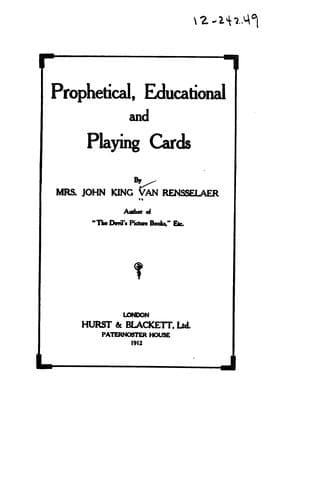
Prophetical, Educational and Playing CardsVan Rensselaer, John King, Mrs.
Religion
Prophetical, Educational and Playing Cards
Van Rensselaer, John King, Mrs.
Fortune-telling by cards -- History; Playing cards -- History
Jack was the name given to all the Knaves in All-Fours, which cognomen has
clung to them. In Euchre, the Knaves of Trumps are called Bowers. The
rules of that game make the Joker the highest card, followed by the Knave
of the suit declared to be trumps, and the Knave of the suit of the same
colour. Thus, if Hearts are trumps, its Knave is called "the right bower,"
and the Knave of Diamonds becomes "the left bower." This word is a
corruption of a dialect word, meaning "young man," and was given to the
Knaves when Euchre was invented, about the middle of the last century, at
the same time that the Joker was reappointed to his old place in the pack.
In Skat and the games from which it has been adapted, such as Tappé Tarot,
of the Austrians; L'Ombre, of the Italians, and Primero, of the Spaniards
and English (to all of which the German game bears a strong resemblance),
the Knaves are called "Matadores." In France, the Knave is called Varlet,
or Valet; in Italy, Fanté; in Spain, Soto; but there are local nicknames
for all the Knaves in different countries and in different games. Obermann
and Untermann, or, for short, Ober and Unter, are printed on the two male
figures in the German packs, where three court cards are retained, but
where no Queens are to be found, although the Tarots had four royal
personages, including a Queen.
The attributes, dresses, and devices of the queens of the card kingdom are
historical and most interesting, for, like their kings and valets, their
fashions have survived unchanged for practically four hundred and
twenty-five years, since the French cards were introduced into England.
None of the faces are in profile, but the Queens of Diamonds and Clubs
incline to our right, while the Queens of Hearts and Spades look towards
our left. The robes are trimmed with ermine and are confined at the waist
by jeweled buckles. A wimple or veil floats from the fair hair that is
parted over the brow and crowned with a diadem, worn quite far back
instead of on the top of the head.
The representation of the Queens on the cards is a close copy of the
costume of the many portraits extant of Elizabeth of York, daughter of
Edward IV of England, wife of Henry VII and mother of Henry VIII. Some of
her likenesses are in different collections in England, the most
interesting one being in the National Portrait Gallery in London.
The picture of Henry VII, which hangs as a pendant to that of his lovely
wife, is marked 1505, or four years before his death, and looks like an
elderly, careworn man, but that of his consort was probably painted at the
time of her marriage, as she is portrayed as a young, sweet-faced woman.
It is this picture that has been placed on the cards, where it has
remained practically unaltered for four centuries, while her husband's
likeness has not been perpetuated among the court cards.
Public-domain text, read in full here on John Shaqi.
Reviews
Reviews
No reviews yet
Be the first to share your thoughts on this work.
Elsewhere in the archive
Join the Discussion
Join the discussion
Sign in to leave a comment or review.
Sign InorCreate an account