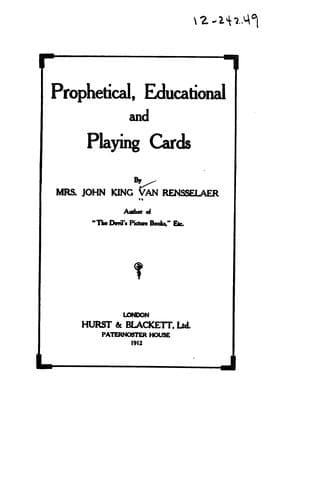
Prophetical, Educational and Playing CardsVan Rensselaer, John King, Mrs.
Religion
Prophetical, Educational and Playing Cards
Van Rensselaer, John King, Mrs.
Fortune-telling by cards -- History; Playing cards -- History
The reason for placing the likeness of Elizabeth of York on the cards may
be briefly stated. She was born in the palace of Westminster, February
11, 1466, and was the eldest child of Edward IV and Elizabeth Woodville.
For some years the little royal princess was heiress to the throne. When
his daughter was about nine years of age, King Edward made an expedition
into France, and war with that country was averted only by her submitting
to become tributary to the invaders. In the articles of peace, the
Princess Elizabeth was contracted to the Dauphin Charles, the eldest son
of Louis XI and the great-grandson of the crazy Charles VI, for whom the
French pips were said to have been invented.
"From the hour of her contract with the heir of France, Elizabeth was
always addressed in the palace," says Miss Strickland in her "Lives of the
Queens of England," "as Mme. la Dauphine," so "the most illustrious Maid
of York" (as she was also called) was taught to speak and write French by
ladies sent to England by Louis. They also dressed the princess in the
latest French fashions. The simple veil of fine white muslin, that had
been the customary court dress, was replaced by a velvet hood with long
lapels heavily jeweled. Flowing sleeves trimmed with ermine took the
place of the tight ones with broad lace cuffs that had formerly been the
style in England, and a robe confined at the waist by a girdle and jeweled
buckle took the place of the stiff, tight bodice. All these items of dress
have been closely copied in the cards, where they may be easily studied.
[Illustration: EARLY ITALIAN TAROTS
Pip and Court Cards of the Sword Suit
61 Seven of Swords
62 Eight of Swords
63 Nine of Swords
64 Ten of Swords
65 Knave of Swords
66 Cavalier of Swords]
Elizabeth was also taught embroidery by her French _dame d'honneur_, but,
above all, was instructed to play with the cards bearing French pips
instead of those with German emblems, showing Acorns, Leaves, Hearts, and
Bells, that were probably used before that time in England, since they are
the only ones found in that country.
The marriage contract was treacherously broken by the French king, who
married his son to Anne of Bretagne, and this slight to the Princess
Elizabeth so infuriated her father that it caused his death.
After years of sorrow and vicissitudes, Elizabeth married Henry VII,
January 16, 1486, thus uniting the houses of York and Lancaster, and her
heraldic rose remains on the cards to remind us of this important event.
John de Gigh, a prebendary of St. Paul's, wrote a Latin epithalamium on
her marriage, and a part of it describes this exalted lady on her wedding
day. A free translation of it may be given as follows:
Public-domain text, read in full here on John Shaqi.
Reviews
Reviews
No reviews yet
Be the first to share your thoughts on this work.
Elsewhere in the archive
Join the Discussion
Join the discussion
Sign in to leave a comment or review.
Sign InorCreate an account