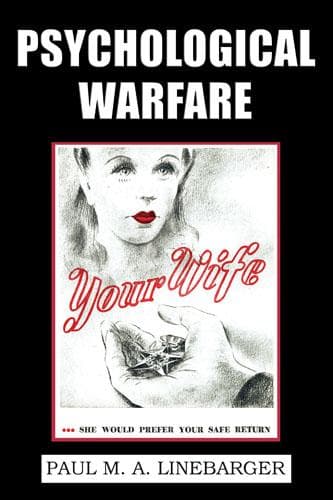
Psychological WarfareLinebarger, Paul Myron Anthony
History
Psychological Warfare
Linebarger, Paul Myron Anthony
Psychological warfare
Psychological warfare can be relied upon to a considerable degree to
step up enemy panic in the application of a rapid forward movement. The
Japanese in China panicked whole regiments of local volunteers plumb out
of existence by the use of fast-marching Chinese-speaking plainclothes
troops, some of whom may have been air-dropped. In the Nazi
establishment of the first salient through to Abbeville, the
psychological aspects of the blitzkrieg helped prevent the British and
French from re-forming a continuous line and led eventually to the
pocketing of the British at Dunkirk.
Psychological warfare can also be counted on, tactically, to speed up
the reduction of isolated enemy positions when these positions are
clearly beyond hope of rescue. All the psychological warfare people need
to do is to go in with map leaflets, surrender leaflets, loudspeakers
and a near-by radio. The unit may not give in instantly, but the unit
would be superhuman if it fought as well in the face of persuasion as it
would have fought without psychological attack. In the mopping-up of
Japanese in the Pacific island fighting, psychological warfare teams and
techniques undoubtedly eased and speeded the process.
These references are to tactical estimates. Strategic propaganda is
beyond estimate. All it can do is to weight the probabilities a little
more favorably than would be the case without it. If the United States
had not dropped the Japanese surrender proposal in Japanese all over
Japan, the Japanese government leaders might have been more inclined to
resist surrendering. If the Germans had not softened up the French
before the Great Western Blitz of 1940, they might have needed more
time, days or weeks more to reduce France, and thus might have faced a
united French overseas Empire even after France-in-Europe fell. The
success of a strategic propaganda operation cannot be guaranteed in any
plan. It would be foolhardy optimism to think that psychology can assume
a major portion of responsibility for direct military results. It would
appear that the Soviet Red Army, despite its propaganda-conscious
Communist background, never passed the whole buck to psychological
warfare. The Russians never appeared to leave the artillery at home in
order to take the loudspeakers or leaflet mortars along. They made
brilliant, almost terrifying use of pre-belligerent propaganda; they
used propaganda tactically with immense success in the taking of
prisoners; they used psychological warfare, with a heavy infusion of
political warfare, more drastically for consolidation and occupation
purposes than did any of the other United Nations. But like everyone
else, they seem to have used strategic propaganda for whatever it might
bring in--immediate generalized effect, and the ultimate production of
windfalls.
Public-domain text, read in full here on John Shaqi.
Reviews
Reviews
No reviews yet
Be the first to share your thoughts on this work.
Elsewhere in the archive
Join the Discussion
Join the discussion
Sign in to leave a comment or review.
Sign InorCreate an account