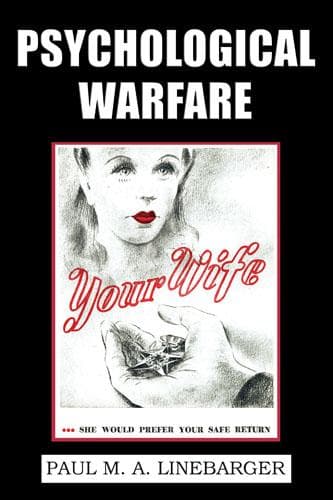
Psychological WarfareLinebarger, Paul Myron Anthony
History
Psychological Warfare
Linebarger, Paul Myron Anthony
Psychological warfare
Every American theater commander, given the choice of using
psychological warfare or not, as he chose, did choose to use it. Every
major government engaged in the war used psychological warfare, along
with a number of assorted private characters, some of whom later founded
governments. (The sacred government of the Dalai Lama, in forbidden
Lhasa, undertook a neat little maneuver in limited overt propaganda when
it printed a brand-new set of stamps for presentation to President
Roosevelt; the Inner Mongols were propagandized by the Outer Mongols;
the Grand Duchy of Luxembourg broadcast against the Reich.)
Psychological warfare proliferated so much as to change the tone if not
the character of war. General Eisenhower wrote, at the end of the
European operations, that psychological warfare had developed as a
specific and effective weapon of war.
The organization of psychological warfare was as much a problem as the
operation. It overlapped military, naval, diplomatic, press,
entertainment, public relations, police power, espionage, commercial,
educational and subversive operations. Almost every nation involved had
extreme difficulty in fitting these new powers and unknown processes
into the accepted frame of government, and almost every national
solution was different. The British and the Japanese achieved a
considerable degree of unification. The Americans, Nazis and Russians
were hampered by the number of competing agencies. The French were
burdened through most of the war by an excess of governments. The
Chinese did things in their own formal but offhand manner; the
Nationalist party carried on information functions for the Chinese
government, while the Communist guerrilla authorities carried on
functions for the Communist party.
[Illustration: _Figure 39: Leaflet Production: Military Presses._ The
machines shown are Davidson presses, widely used by the Americans in all
theaters of war. The unit shown is Psychological Warfare Branch during
the Leyte operations. The leaflet being run off is addressed to both
Filipino guerrillas and Japanese troops, facilitating a difficult
three-way operations whereby Japanese are told to surrender to
Filipinos, Filipinos told not to kill surrendering Japanese, and
Americans instructed to receive prisoners from Filipinos.]
[Illustration: _Figure 40: Leaflet Production: Rolling._ When round
bombs were used, the leaflets had to be rolled into round packages to
fit. Forty thousand leaflets could be packed into one bomb, and a
Mitchell bomber could carry seventeen such bombs. (Photo by Ninth Air
Force Combat Camera Unit.)]
Public-domain text, read in full here on John Shaqi.
Reviews
Reviews
No reviews yet
Be the first to share your thoughts on this work.
Elsewhere in the archive
Join the Discussion
Join the discussion
Sign in to leave a comment or review.
Sign InorCreate an account