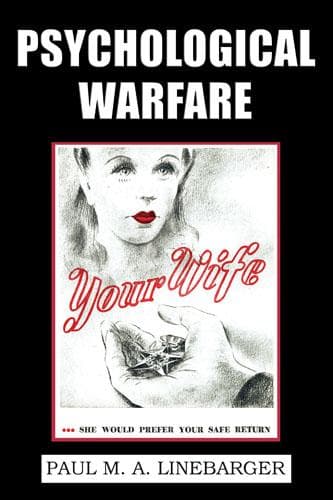
Psychological WarfareLinebarger, Paul Myron Anthony
History
Psychological Warfare
Linebarger, Paul Myron Anthony
Psychological warfare
What could a commander do if a delegation called on him, right out in a
zone of operations, and demanded a right to be heard? Suppose that he
knew their complaints about food, rotation, danger, etc., to be
justified, and knew at the same time that the enemy had subverted some
of his men into being either dupes or traitors. Suppose his men
protested a lack of deep lead-lined shelters the day after enemy
leaflets instructed the American soldiers to ask for such shelters.
Should he treat all such enlisted men as traitors? Suppose he is faced
with the specter of political treason, subversion, and revolution?
American officers have not faced such problems since the days in which
George Washington was Commander in Chief. War after war, we have gone
into the fight with a profound confidence in our ability to win. Future
war may hold forth no such assurance. If America is injured, her troops
decimated, their homes exploded or poisoned by foreign atomic attack,
brand-new questions of psychological warfare will be posed. No living
American has ever had to face such problems. This is no assurance that
they will never occur. Upon the manhood, the fairness, the sheer
intelligence of small-unit commanders there may fall the unexpected task
of holding their units together in the face of disastrous psychological
attack.
=Surrender Leaflets.= Surrender leaflets are the infantry of the
propaganda war. They go in and finish the job to which the preceding
years of radio broadcasts, the demoralization of the home front, the
campaigns of news and morale materials to troops, and the actual air,
ground, and sea attacks have led up.
Sudden use of surrender leaflets on a victorious or unprepared enemy is
not likely to take effect. The Japanese surrender leaflets dropped on
the Americans in Southwest Pacific were issued without previous
materials readying the Americans. Furthermore, they were dropped when
the American situation was plainly improving, and when American soldiers
were not likely to be thinking about surrender in order to get
individual escape from the war.
Public-domain text, read in full here on John Shaqi.
Reviews
Reviews
No reviews yet
Be the first to share your thoughts on this work.
Elsewhere in the archive
Join the Discussion
Join the discussion
Sign in to leave a comment or review.
Sign InorCreate an account