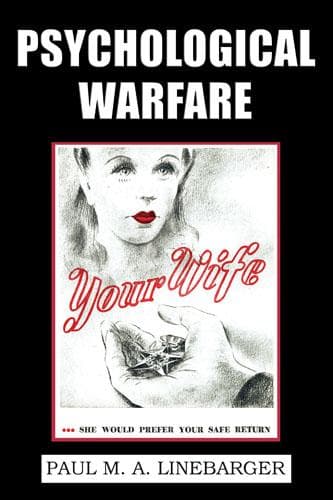
Psychological WarfareLinebarger, Paul Myron Anthony
History
Psychological Warfare
Linebarger, Paul Myron Anthony
Psychological warfare
The preparation of surrender leaflets calls for the tactical use of
printing facilities. This is the job of the combat propaganda unit, with
its high-speed press, its liaison with both ground and air forces, its
up-to-the-minute intelligence on enemy movements, situation, and order
of battle. The enemy should be given leaflets showing him how clearly he
is pinned down, identifying him, generally stripping him of the sense of
secrecy and the trust in his commanders that make it possible for him to
go on fighting. When surrender can be effected, he should be given the
simplest, plainest command the circumstances allow. In the case of the
Japanese, there were difficulties on the American side about letting the
Japanese come over to surrender; too many of them were suspected of
having tucked hand grenades into their _fundoshi_. Many a Japanese
started out for the Allied lines and failed to make his peaceful
intentions plain enough. The result was a strong deterrent to other
Japanese who may have been trying to decide whether they wanted to
surrender or not.
[Illustration: _Figure 63: Action Type: Air-Rescue Facilities._ These
leaflets from China Theater were designed to help the work of the
Fourteenth Air Force. Action called for from the civilians included the
assistance of hurt flyers, the identification of Americans as allies and
not as Japanese when they parachuted to the ground, the avoidance of
bridges and other bomb targets.]
It was found that the bright white leaflet with the identifying stripes
on it (figure 69) would be shown to our troops, who could be taught to
hold their fire when they saw Japanese carrying that type of leaflet.
To the Japanese, the plainness of the surrender formula was a
considerable help in coming over.
[Illustration: _Figure 64: Pre-Action News._ Psychological warfare
facilities can be extremely helpful in favorable situations. One of the
most important ways of developing a favorable situation is to predispose
enemy soldiers toward the idea of surrendering. News of surrender,
emphasis on the comforts and relief of prisoners of war, and above all,
emphasis on their numerousness can contribute to the actual act of
surrender. This newspaper looks like a newspaper, but its chief emphasis
is on the extent of surrenders.]
Variations on the surrender leaflet include the following devices:
Letters, with signatures blacked out, of prisoners of war who have
found conditions decent and who are enjoying rest, good care, and good
food;
Photographs, with the faces blocked out when security procedures or
the rules of war so require, showing enemy prisoners actually enjoying
the benefits of being out of the war;
Political arguments to the effect that the highest duty of the soldier
is to his country (or Emperor) and that if he dies for the sake of
some general in a foolish war, he will be denying his country a fine
postwar citizen like himself, needed for reconstruction and progress;
Public-domain text, read in full here on John Shaqi.
Reviews
Reviews
No reviews yet
Be the first to share your thoughts on this work.
Elsewhere in the archive
Join the Discussion
Join the discussion
Sign in to leave a comment or review.
Sign InorCreate an account