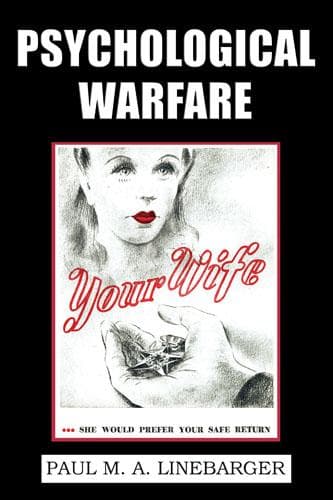
Psychological WarfareLinebarger, Paul Myron Anthony
History
Psychological Warfare
Linebarger, Paul Myron Anthony
Psychological warfare
The strategic PsyWar self-limitations imposed by the United States on
the United States in the Korean war were also crippling. The United
States did not desire anything which a professional soldier would
recognize as victory. U.S. opinion was divided as to whether all of
Korea should be liberated by UN forces. At the policy-making
level--certainly among our allies--there was pretty general agreement to
remain at peace with the supply dumps and high command of the Chinese
Communist forces in Manchuria and China while fighting the forward
echelons of those forces in Korea. The United States would not accept
defeat nor would it seek a decisive victory because victory might have
involved the risk of war.
Under these conditions it must be pointed out that General MacArthur had
the first and only PsyWar establishment ready to operate the moment the
Korean war began. Col. J. Woodall Greene ably managed the Tokyo
headquarters for most of the period of the Korean war. The Department of
the Army showed great good judgment in bringing back Brig. Gen. Robert
McClure, who had been Eisenhower's PsyWar chief in Europe, to the new
Department of the Army's PsyWar establishment which was created on 15
January 1951 in the Pentagon as a part of Special Staff, United States
Army, with the title of Office of the Chief of Psychological Warfare
(OCPW). When General McClure departed for Teheran, he was succeeded at
OCPW by Brig. Gen. William Bullock. The last period of the Korean war
found Korean local PsyWar at the headquarters of Eighth U.S. Army in
Korea (EUSAK) under the command of Col. Donald Hall, who had probably
seen more continuous PsyWar service than any other officer in the U.S.
Army.
CHAPTER 15
Strategic International Information Operations
From 1776 to 1945 the U.S. system of government managed to survive in a
world comprising many types of government without setting up its own
propaganda and agitational forces. Propaganda through most of the
twentieth century was pretty clearly limited by the U.S. conception of
propaganda as a weapon auxiliary to war. "Psychological warfare" became
proper, in conventional American terms, only when there was a war to be
won. With the coming of peace in 1945 there was considerable uncertainty
as to whether the United States should have a propaganda establishment
at all.
Even at the time of writing (1954) there is still some doubt as to
whether the United States needs propaganda facilities. The William
Jackson report of July 1953 indicated that the terms _propaganda_ and
_psychological warfare_ were unsatisfactory. Of course they were. They
still are. The world itself is unsatisfactory--in terms of the
traditional, humane, rational U.S. point of view.
Public-domain text, read in full here on John Shaqi.
Reviews
Reviews
No reviews yet
Be the first to share your thoughts on this work.
Elsewhere in the archive
Join the Discussion
Join the discussion
Sign in to leave a comment or review.
Sign InorCreate an account