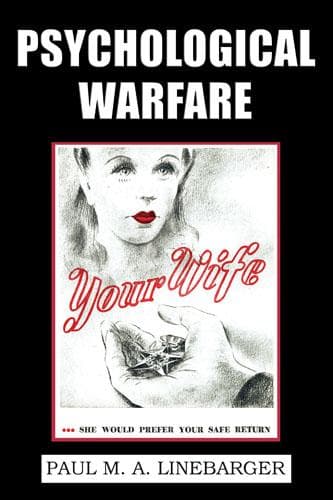
Psychological WarfareLinebarger, Paul Myron Anthony
History
Psychological Warfare
Linebarger, Paul Myron Anthony
Psychological warfare
The story of U.S. "peacetime" propaganda since the end of World War II
is a very complicated one. Quantity, direction, purpose, and quality
have shifted with the various turns of the international situation. The
subject has become much more difficult to write about since the time the
first edition of this book was written in 1946.
In the first place, governmental secrecy has been very sharply restored.
Even very routine State Department operations for putting across the
U.S. point of view have been shrouded in masses of classified documents.
For reasons not always evident to the outside observer, the assumption
has become prevalent that the normal operations of the United States
Government should be kept confidential, secret, or even top secret.
Often it would seem that the attempt to maintain secrecy in
non-sensitive functions is not worth the security effort at all or,
contrariwise, may even reassure the antagonists of the United States by
not letting them realize how serious and how unfriendly our plans or
policies with respect to them may be. (This is not the time or place to
discuss the problem of secrecy as a protection against domestic
criticism--which secrecy, of course, has often become, to the detriment
of both the government and the citizens of the United States.)
In the second place, not only have information activities become more
hush-hush: they have also become more complicated. It is difficult to do
justice to an intricate moving panorama of activities, some of which may
not be mentioned or described under existing law.
=Demobilization and Remobilization.= The ending of the OWI and the
installation of the International Information Service, mentioned above
on page 184, in turn changed into the information activities of the
Department of State. These were headed from 1945 to 1953 by an Assistant
Secretary of State for Public Affairs. In 1953 a Director of the United
States Information Agency, _not_ under the Department of State but
mysteriously attached to the National Security Council, was inaugurated.
The overseas operating component of USIA remained the United States
Information Service (USIS), transferred from State Department control.
In other words, there were eight years in which the Department of State
had primary responsibility for the conduct of peacetime propaganda of
the United States. This was the first and only time that the United
States Government had in a period of relative peace undertaken a
sustained propaganda effort.
The effort had ups and downs because neither the citizenry nor the
officials knew whether the country was in a condition of peace or at war
and, if at war, at war with _whom_. To some the enemy was Communism, the
ideology; to others, Communism the movement; to still others, the USSR;
to others, the Korean Communists, but not the Chinese Communists; to
others, the Chinese Communists in Korea, but not the Chinese Communists
in China; and so on, _ad infinitum_.
Public-domain text, read in full here on John Shaqi.
Reviews
Reviews
No reviews yet
Be the first to share your thoughts on this work.
Elsewhere in the archive
Join the Discussion
Join the discussion
Sign in to leave a comment or review.
Sign InorCreate an account