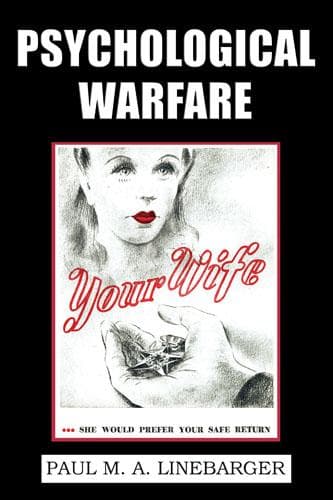
Psychological WarfareLinebarger, Paul Myron Anthony
History
Psychological Warfare
Linebarger, Paul Myron Anthony
Psychological warfare
The general history of these eight years was, by and large, a first
phase in which the United States demobilized or destroyed propaganda
facilities which had been built up with great skill and at great cost
during World War II, and a second phase in which those facilities were
partially rebuilt and the skills rediscovered. The low point in this
development was probably the winter of 1947-48.
For a while, the rumor went around Washington that the Secretary of
Defense, Louis Johnson, would not tolerate the utterance of the words
_propaganda_ or _psychological warfare_, and that the Secretary of the
Army, Kenneth C. Royall, refused to have the topic mentioned to him.
That may be the exaggeration characteristic of newspapermen, but it
epitomized the spirit of that time.
While "psychological warfare" almost disappeared from the Department of
Defense and the three services during this low point, the State
Department never quite demobilized. For one thing, the State Department
had inherited the OWI facilities and the Army facilities in the occupied
countries--Austria, Germany, Korea, and Japan. As the heir to
substantial informational facilities the State Department kept a
certain minimum activity going. Facilities such as American Broadcasting
Station in Europe (ABSIE), Radio in the American Sector--of
Berlin--(RIAS), the Information Control Commands in the American Sector
of Germany, Information and Education (I&E) Section of the General
Headquarters of the Supreme Commander for the Allied Powers (SCAP) in
Japan--these (though sometimes renamed) represented going propaganda
concerns which required a Washington command post.
Meanwhile, it became standing operating procedure in the U.S. diplomatic
establishment to attach some kind of an informational facility to every
diplomatic establishment and to most of the major consulates.
Since there were always advocates of complete propaganda dismantlement,
as well as enthusiasts for the maintenance of information programs, the
issue of remaining in the propaganda business or getting out was always
more or less in doubt. The economy and the demobilization phases of 1947
and 1948 were stimulated by evidence of Soviet bad faith in Europe
during 1949 and brought into sharp focus by the outbreak of the Korean
semi-war in 1950.
It is not possible to do justice to all these different systems in a
single phrase. Even as late as the present, it is sometimes difficult to
determine why the U.S. need have an information program operating in
such entirely friendly countries as Cuba, Haiti, Ireland, or Australia.
There is some point to the argument set forth by ultraconservatives that
what was good enough for Theodore Roosevelt ought to be good enough
today; that, in other words, the United States should be known for what
it is and not by what a few hired promoters can say about it.
Public-domain text, read in full here on John Shaqi.
Reviews
Reviews
No reviews yet
Be the first to share your thoughts on this work.
Elsewhere in the archive
Join the Discussion
Join the discussion
Sign in to leave a comment or review.
Sign InorCreate an account