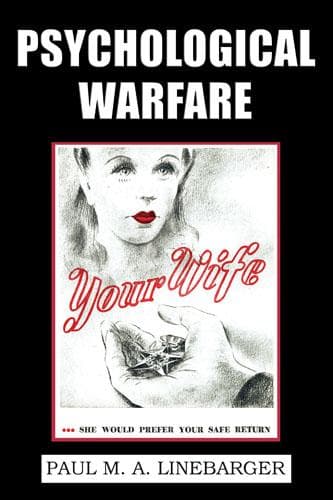
Psychological WarfareLinebarger, Paul Myron Anthony
History
Psychological Warfare
Linebarger, Paul Myron Anthony
Psychological warfare
The advantage of the RFE and RFA type of operation is that by giving
voice to independent nongovernmental resistance to Communism it has
often been possible to go far beyond the limits which intergovernmental
protocol would impose upon U.S. official broadcasts. That is, the United
States can scarcely describe a deputy minister in the Rumanian
Government as a scoundrel, thief, pervert, or renegade; Rumanian exiles
allowed access to Radio Free Europe stations need have no such
limitations. On the other hand, there is the difficulty that Radio Free
Europe, because of its U.S.-based finance and management might lend an
unnecessary U.S. sponsorship to genuinely independent anti-Communist
undertakings. Here again, as in the case of the reconciliation of the
State Department and Defense broadcasts, it is impossible to draw a
doctrinal rule which would prescribe on one hand that all propaganda
broadcasts should be unofficial or that they should all be official. One
cannot even say that they should all be coordinated.
=The Psychological Strategy Board.= Coordination was nevertheless
attempted--at least for the governmental side. In 1951 President Truman
created the Psychological Strategy Board, bringing the versatile and
judicious Gordon Gray back to Washington for the purpose. The prescribed
role of the Board was to coordinate, plan, and phase all United States
information policies so as to achieve maximum effect from the
governmental effort; not once did the Board dare reach out for a penny's
worth of jurisdiction over private U.S. facilities. The Psychological
Strategy Board was only originally under the chairmanship of the
Director of the Central Intelligence Agency, then General Walter Bedell
Smith, with the members of the Board consisting of the Under Secretary
of State, the Under Secretary of Defense, and the Deputy Director of
what was at the time known as ECA, later MSA. The Board had a series of
able staff directors and small staffs detailed from other Government
departments on a permanent basis to serve as a working secretariat. The
precise operations of the Board were cloaked in extraordinary secrecy.
It cannot be said that U.S. propaganda worsened in the two years
following the establishment of the Board; neither can it be said that
U.S. PsyWar operations scored any coups so striking as to deserve a
position in the annals of international affairs.
Public-domain text, read in full here on John Shaqi.
Reviews
Reviews
No reviews yet
Be the first to share your thoughts on this work.
Elsewhere in the archive
Join the Discussion
Join the discussion
Sign in to leave a comment or review.
Sign InorCreate an account