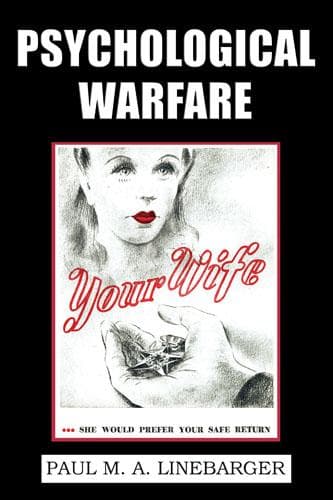
Psychological WarfareLinebarger, Paul Myron Anthony
History
Psychological Warfare
Linebarger, Paul Myron Anthony
Psychological warfare
American strength cannot be sought in unanimity. U.S. propaganda is
incapable of pulling the Sudeten rabbit out of a Munich hat. Short of an
intimate and extreme danger of war itself, the U.S. Government cannot
threaten a foreign government very successfully; too many U.S. citizens
would immediately shout at one another, at their own government, and to
the foreigners concerned: "Those Washington officials don't really mean
it! We don't want war. We're not going to go through with it." If the
USA moved against Spain, there are friends of Franco in Washington who
would tell him to sit tight; if the USA moved too rapidly against the
Communist world, there are plenty of Americans, both in and out of
government, who would say privately, through the press, or by letters
that the Indian Government or some other should assure Moscow and
Peip'ing that the U.S. would not dare carry through.
Exploitation of U.S. propaganda strength must therefore always be
developed from _the probable or apparent "center" of American opinion at
that moment_. It is impossible to find a U.S. policy which can be made
compulsory and unanimous upon all Americans both public and private. It
is not impossible through an adroit combination of the skills of
leadership, foresight, and a keen awareness of intra-U.S. politics to
devise foreign-policy programs which will command the decisive assent of
the American people.
=War and Unanimity.= The less peaceful the world is, the more effective
a peacetime information program can be. The attack of the Communist
aggressors in Korea, which involved the U.S. armed forces, pushed the
U.S. public into line behind the U.S. Government in a way which no
degree of propaganda manipulation from Washington could have contrived.
In times of danger the American people stick together. In times of
relaxation they scatter about. One should not plan a crusade for the
American people to carry out unless one is sure that someone on the
outside will goad the American people with repeated stings of danger or
trouble.
Once war breaks out, the American people have in the past shown a very
good capacity to unite in winning and finishing the war. There is no
reason to suppose that the situation will be different in the future.
What is perplexing, and for the present insoluble, is this: how can the
American people, short of getting involved in war, become so purposeful,
so decisive, so nearly unanimous, as to take actions which will prevent
a war? The situation in the early 1950s is on the Communist side a major
crusade against what the Reds regarded, or pretended to regard, as
"aggressive" U.S. capitalist power.
Public-domain text, read in full here on John Shaqi.
Reviews
Reviews
No reviews yet
Be the first to share your thoughts on this work.
Elsewhere in the archive
Join the Discussion
Join the discussion
Sign in to leave a comment or review.
Sign InorCreate an account