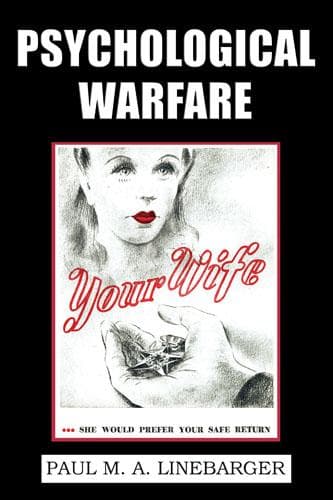
Psychological WarfareLinebarger, Paul Myron Anthony
History
Psychological Warfare
Linebarger, Paul Myron Anthony
Psychological warfare
=Philosophy and Propaganda Development.= In terms of specific literature
of PsyWar it is difficult to find many contributions of professional
philosophers to PsyWar since the end of World War II. This is curious,
in view of the Communist propagation of philosophy, no matter how
perverted its form, as a major weapon. The American philosopher, Dr.
George Morgan, who became a career diplomat, was simultaneously a
Soviet-area expert and a key figure in the Psychological Strategy Board.
There were not many others like him.
Philosophy offers an opportunity for the reexamination of cultural
values. The indoctrination of those professors who will teach the
teachers of the generation after next will influence the capacity of
future Americans to have a world-view which will give them the utmost
opportunities for action in the military field while retaining as far as
possible the blessings of U.S. civilian civilization. That U.S.
civilization is still civilian and not military is, of course, beyond
cavil.
The William Jackson committee was a voice crying in the wilderness when
it asked for new terms and new ideas against which to set U.S.
propaganda operations in the world of modern strategy. Philosophers may
have had the capacity for finding some of the answers, but philosophers,
of all people, do not like to be jostled or hurried. The author has
never heard of a philosopher employed on a confidential basis by the
United States Government to think through the historical and cultural
rationale of a U.S. military victory for the future. Writers such as F.
S. C. Northrop and Erich Fromm--to name only two sharply contrasting
personalities--have written books which possess high significance for
the international propaganda field. The connection appears, however, to
be tangential.
=Literary Contributions.= Almost all the best propagandists of almost
all modern powers have been, to a greater or less degree, literary
personalities. The artistic and cultural aspect of writing is readily
converted to propaganda usage. Elmer Davis is a novelist as well as a
commentator. Robert Sherwood is one of America's most distinguished
playwrights. Benito Mussolini wrote a bad novel. Mao Tse-tung is a poet
and philosopher, as well as a Communist party boss. Down among the
workers in the field, such American novelists as James Gould Cozzens,
Pat Frank, Jerome Weidman, and Murray Dyer, have worked on U.S.
psychological warfare.[59]
Though literary men have converted their writing to propaganda purposes,
few of them have gone on to define the characteristics of a specific
conversionary literature or to compile canons of literary style
applicable to the propaganda field. The contributions may lie in the
future.
Public-domain text, read in full here on John Shaqi.
Reviews
Reviews
No reviews yet
Be the first to share your thoughts on this work.
Elsewhere in the archive
Join the Discussion
Join the discussion
Sign in to leave a comment or review.
Sign InorCreate an account