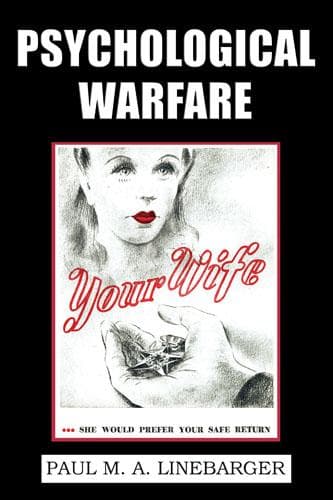
Psychological WarfareLinebarger, Paul Myron Anthony
History
Psychological Warfare
Linebarger, Paul Myron Anthony
Psychological warfare
The scientific problem presented by attempted serious study of a
U.S.-Soviet war is therefore very difficult indeed. It is really a
problem involving three clusters of moving bodies. The first cluster
will be the American people, their behavior, and their institutions; the
second cluster, the Russians and allied peoples, their behavior and
their institutions; the third cluster, the changing methods of
communication existing between them.
It can be said even now, simply by referring to the character of the
American people and their past history, that if the Communist leaders of
the USSR start a general war, the end of that war is sure (under sets of
words and ideas which have yet to be developed in the future) to involve
the reconciliation of the inhabitants of the USA with the Russian
people. In other words, USA_{v} and USSR_{v} can and must have certain
relationships with each other, preeminent among which are attempts at
undoing war damage, at political and cultural reconciliation, and the
undertaking of the rebuilding of a world which both these great peoples
can support with enthusiasm and _hope_.[61]
USA_{v} and USSR_{v} are imaginable. USA_{1} and USSR_{1} for the day
preceding the outbreak of war, or, alternatively, the day on which the
war occurs, will be known elements. American science in many fields can
help U.S. mass communications and therewith help our armed forces if we
learn how to ascertain how the Soviet leadership changes, how Soviet
élite groups change, and how the Soviet population changes during the
course of the war. We must not only be able to guess what is happening
to them physically, but must try to appreciate and to understand what is
happening to them psychologically and semantically. This is an immense
task. It is by no means certain that our research and development
facilities can give us an adequate research program to handle the
problem.
This much can be said: if the Americans understand the Russians before
the war and during the war, it will be the first time that a nation has
kept its enemy in wide-awake sight.
The usual process in the past has been the acceptance of a few
exaggerated stereotypes of the national characteristics of the potential
enemy, the ascription of every possible kind of infamy and inhuman
characteristic to the enemy during the war, and the redefinition of the
enemy as a friend after the war. It would be strange and wonderful if
the U.S. Government and the U.S. propagandists (or conceivably as much
as a large minority of the U.S. population) could learn how to fight the
USSR in order to _help_ the Russians escape from a tyranny which has
already hurt them much more than it has hurt us.
Public-domain text, read in full here on John Shaqi.
Reviews
Reviews
No reviews yet
Be the first to share your thoughts on this work.
Elsewhere in the archive
Join the Discussion
Join the discussion
Sign in to leave a comment or review.
Sign InorCreate an account