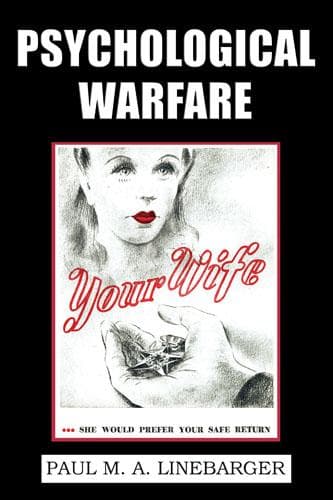
Psychological WarfareLinebarger, Paul Myron Anthony
History
Psychological Warfare
Linebarger, Paul Myron Anthony
Psychological warfare
On the other side of the coin, it is very hopeful to note that the many
and dangerous techniques developed by OSS for covert propaganda, some of
which were applied with considerable success in Europe, have not been
introduced into domestic U.S. politics, commercial competition, or other
forms of private life. After each war there is often a danger that the
coarsening of a culture by the war will lead to the application of
wartime skills to peacetime situations. This was emphatically not the
case in the Presidential campaigns of 1948 and 1952, even though persons
of rich PsyWar experience in World War II were on the staffs of both
Stevenson and Eisenhower.
It is often forgotten that some of the deadliest and most effective
revolutionary enterprises in the nineteenth century were undertaken
without the consent or assistance of the existing governments. Karl Marx
was certainly not an invention of Lord Palmerston. Bakunin did not
operate out of the French Foreign Office.
In the postwar discussion of USA-Communist rivalry, recommendations were
often made on the U.S. side that we should counter Soviet covert
operations with our own covert operations against the USSR. What has
been forgotten in this context is the fact that such operations have
been made illegal and dangerous under United States law. Under Federal
law as it exists today no Underground Railway could be developed to
assist Soviet escapers in the way that Negro slaves were relayed across
the Free States to Canada in the years before Emancipation. One of the
chief blocks to U.S. covert operations is the immense growth in all
directions of the power, authority, and responsibility of the Federal
Government; this growth makes it almost impossible to wage revolutionary
or conspiratorial operations from U.S. territory without the prior
approval of U.S. authorities--which the authorities, under traditional
international law, cannot give and cannot afford to give.
It would seem desirable, if the Cold War situation persists over a long
period of time, for Americans to reexamine the restraints which they
have placed upon their own citizens and to attempt a revision of the
laws which would permit pro-American secret activities to be launched
without permitting anti-American activities of the same kind to be
carried on. One immediately comes to the conundrum:[63]
How can the Government say _yes_ to the one and _no_ to the other
without being cognizant of what happens?
The answer would appear to lie in the older body of our law in that a
withdrawal of governmental authority from some fields would leave the
individual responsible and subject to indictment and trial if his
enterprises should prove deleterious to the United States Government,
but not subject to punishment if his enterprises hurt the known
antagonists of the USA.
Public-domain text, read in full here on John Shaqi.
Reviews
Reviews
No reviews yet
Be the first to share your thoughts on this work.
Elsewhere in the archive
Join the Discussion
Join the discussion
Sign in to leave a comment or review.
Sign InorCreate an account