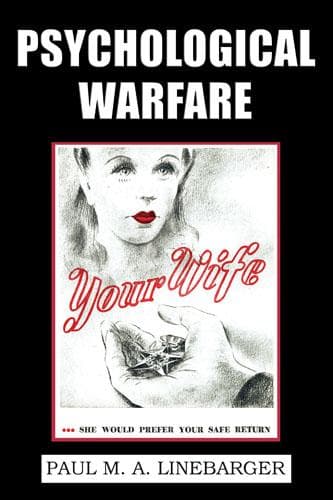
Psychological WarfareLinebarger, Paul Myron Anthony
History
Psychological Warfare
Linebarger, Paul Myron Anthony
Psychological warfare
Phrased in another way, this means that the USA might, in a long-range
Cold War situation, be required to make some domestic recognition of the
fact that the Communist states are the antagonists but not the military
enemies of the U.S. system of government and that as antagonists of this
system of government such states, their representatives, their property,
and their organizations, should not be afforded any more protection
under our laws than is given to the National City Bank of New York in
the laws applicable to the city of Moscow, or the American Telephone &
Telegraph Company in the laws which apply in Budapest. For a long time
the Communist states have treated even the most innocent business
enterprise and social club on our side as though they were attainted
with an inherent factor of criminal and subversive intent. The
withdrawal of U.S. legal protection from all things Communist might
allow the American people--or those among them who so chose--to develop
proclivities for adventure and trouble-making against the Communists.
These proclivities are now sternly repressed by Federal statute.
=The Future of Psychological Warfare.= PsyWar has become an existing
art. Where it had no practitioners at all in the United States between
1919 and 1940, it has had a long and distinguished roster of active and
reserve officers, civilian consultants, and demobilized veterans
interested in the field ever since 1945. A wide variety of military
establishments have had PsyWar responsibilities assigned them.
Substantial cadres of officers and skilled enlisted personnel have been
recruited and trained. Radio and leaflet facilities are ready to
accompany our land, sea, and air forces wherever they may have to go. A
U.S. strategic center for global propaganda, instantly convertible to
wartime use, exists in the Operations Coordinating Board under the
National Security Council.
This is not the end of the story.
One of the paradoxical but deeply true factors in the study and conduct
of propaganda is this: the more people know about propaganda, the better
they can resist it.
Propaganda was a tremendous bogey in the 1920s. It probably seems very
ugly and frightening to most people born before 1920. It does not seem
too frightening, so far as the author can judge, to Americans born after
1930. Those born in the period 1920-30 appear to be divided in their
emotional reactions to mass persuasion situations.
PsyWar is not magic. It is a valuable auxiliary to modern warfare and a
useful concomitant to modern strategy. If a particular strategic policy
is sanely and effectively devised as a feasible deterrent to war, the
PsyWar procedures supporting that strategy will contribute to the
prevention of war. Psychological warfare represents a recognition and
acceptance in the military and strategic field of skills which grow
about us every day.
Public-domain text, read in full here on John Shaqi.
Reviews
Reviews
No reviews yet
Be the first to share your thoughts on this work.
Elsewhere in the archive
Join the Discussion
Join the discussion
Sign in to leave a comment or review.
Sign InorCreate an account