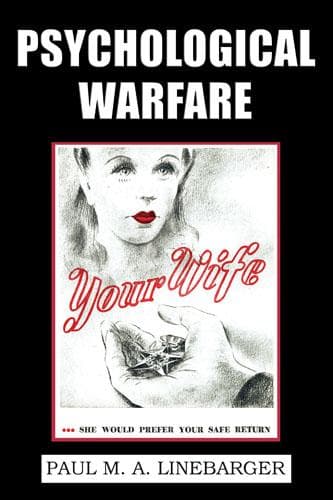
Psychological WarfareLinebarger, Paul Myron Anthony
History
Psychological Warfare
Linebarger, Paul Myron Anthony
Psychological warfare
Some critics of the PsyWar operations in the Far East Command charged
that there were exaggerated claims of prisoners of war who surrendered
as a result of propaganda. They pointed out that a head count of
prisoners is an inaccurate measure of _direct_ effects of PsyWar used in
support of military operations, because rarely is the taking of
prisoners the _sole_ goal of any major PsyWar campaign.
Other critics expressed the belief that emphasis had been placed on
_quantity_ rather than _quality_ of propaganda. By quantity they meant
propaganda measured by bookkeeping statistics. By quality they meant
propaganda that, planned with potent intelligence, was capable of
exploiting propaganda opportunities with maximum psychological impact.
Did PsyWar achieve its goal?
The effects of planned persuasion in a thousand days of radio
broadcasts, in tens of thousands of loudspeaker appeals, in billions of
leaflets, may be measured only in retrospect. The question may be
answered when reaction in the target area has reached (or fails to
reach) favorable proportion, provided that the tangible results of the
military operations can be clearly separated from those of concurrent
and subsequent strategic international information operations.
[Illustration: _Figure 79: The Famous Airplane Surrender Leaflet._ This
is the controversial Far East Command leaflet that in April 1953 offered
"the sum of 50,000 U.S. dollars to any pilot who delivers a modern,
operational, combat-type jet aircraft in flyable condition to South
Korea. The first pilot who delivers such a jet aircraft to the free
world will receive an additional 50,000 U.S. dollars bonus for his
bravery." The leaflet was printed in three languages--Russian, Chinese
and Korean. In this example of the Russian language leaflet, there are
added notations in both Korean and Chinese that "this is a message from
the Americans to any jet pilot who can read Russian. If you know such a
person, please give it to him. It tells him how to escape to the UN
Forces."]
FOOTNOTES:
[1] Histories of warfare, of politics (though there are no good recent
ones, Edward Jenks' little book being half a century out of date), of
political theory (especially the excellent though dissimilar volumes by
G. H. Sabine and by G. E. C. Catlin), of particular countries, of
diplomacy, of religion, and even of literature all cast a certain amount
of light on the subject. No writer known to the author specializes in
the topic of historical propaganda; none takes up the long-established
historical role of non-violent persuasion in warfare. Some of the
sociologists and anthropologists, such as Karl Mannheim, Max Weber,
Talcott Parsons, Geoffrey Gorer, Ruth Benedict (to mention a few at
random) have presented approaches which would justify re-evaluations of
history in a way useful to propaganda students; but they have not yet
persuaded the historians to do the work.
[2] 7 Judges 22-23.
Public-domain text, read in full here on John Shaqi.
Reviews
Reviews
No reviews yet
Be the first to share your thoughts on this work.
Elsewhere in the archive
Join the Discussion
Join the discussion
Sign in to leave a comment or review.
Sign InorCreate an account