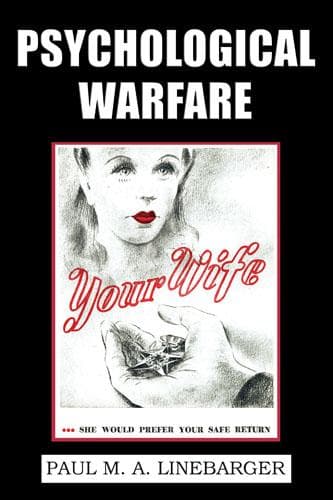
Psychological WarfareLinebarger, Paul Myron Anthony
History
Psychological Warfare
Linebarger, Paul Myron Anthony
Psychological warfare
[3] Leon Wieger, S. J., _Textes Historiques_, Hsien-hsien, 1929, vol. 1,
pp. 628-633.
[4] The author's attention to this reference was drawn by an unpublished
undated typescript article in the War Department files by Lt. Col.
Samuel T. Mackall, Inf.
[5] Lo Kuan-chung, _San Kuo chih Yen-i_, translated by C. H.
Brewitt-Taylor as _San Kuo or Romance of the Three Kingdoms_, Shanghai,
1929, vol. 1, p. 46.
[6] Recent writers on Genghis, such as Lamb, Vladimirtsov, Fox and
Lattimore all credit the Mongols with a higher technological level of
warfare than has been the custom among most Western historians. H. G.
Wells' simple but compelling description of the Mongols in his _Outline
of History_ is worth re-reading in this connection.
[7] Petis de la Croix, _The History of Genghizcan the Great, First
Emperor of the Antient Moguls and Tartars_ ..., London, 1722, p. 154.
[8] Benedict Figken, _Historia Fanaticorum_, Danzig, 1664.
[9] Philip Davidson's _Propaganda and the American Revolution_, Chapel
Hill, 1941, is a careful scholarly study of this period. Comparable
studies have not yet been written concerning other American wars.
Military and civilian historians have a fascinating piece of research
awaiting them in the material concerning Confederate and Federal
psychological warfare. Each participant in the Civil War was vulnerable
to the propaganda of the other. Subversive and clandestine
pro-Confederate propaganda in the North is outlined in George Fort
Milton's engrossing _Abraham Lincoln and the Fifth Column_, New York and
Washington, D. C., 1942, but no comparable study covering all forms of
propaganda on either side is yet available.
[10] Various new editions of Paine's chief works are available in
popular and inexpensive form. They are worth study as good propaganda.
[11] In his _The Political Doctrines of Sun Yat-sen_, Baltimore, 1937,
page 17 and following, this author attempted to present some of the
relationships of ideology to other methods of social control and, in
connection with that enterprise, was furnished by the philosopher, A.O.
Lovejoy, with a definition of "ideology" more systematic and more
elaborate than the one used here.
[12] For example, in the 1920's the Soviet press expressed resentment
and amusement over a ruse adopted by the British during the course of
operations along the Northwest Frontier. Plane-mounted loudspeakers had
told the tribesmen, in Pushtu, that God was mad at them for having
broken the pledged peace, with the result that they scattered and gave
up. This maneuver exasperated the Russians, who themselves were making
equally sweeping propaganda inroads on the other side of the Pamirs. The
Russians were attacking religion, and having heavy going; it struck them
as improper warfare to make use of local superstition.
[13] _Webster's New International Dictionary_, Second Edition,
Springfield, 1944.
Public-domain text, read in full here on John Shaqi.
Reviews
Reviews
No reviews yet
Be the first to share your thoughts on this work.
Elsewhere in the archive
Join the Discussion
Join the discussion
Sign in to leave a comment or review.
Sign InorCreate an account