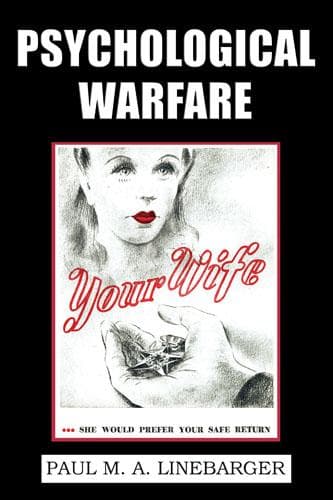
Psychological WarfareLinebarger, Paul Myron Anthony
History
Psychological Warfare
Linebarger, Paul Myron Anthony
Psychological warfare
[15] The literature in this field is carefully described in two volumes
by a three-man team consisting of Harold D. Lasswell, Ralph D. Casey and
Bruce Lannes Smith, the first being _Propaganda and Promotional
Activities, An Annotated Bibliography_, Minneapolis, 1935, and the
sequel being _Propaganda, Communication and Public Opinion, A
Comprehensive Reference Guide_, Princeton, 1946. The booklists provide
material in plenty for any academic-minded inquirer. The essays in the
two volumes are well worth reading, although the authors have undergone
the professorial delight of inventing a private language of their own.
Parts of the latter book, especially, read like proceedings out of an
unfamiliar lodge meeting; but there is sound sense and acute observation
behind the vocabulary. It must, however, be parenthetically noted that
during World War II the key propaganda jobs were held by a radio
commentator, a dramatist, a newspaperman, a New York banker, and an
absolutely astonishing number of men from commercial radio--along, of
course, with a sprinkling of Army and Navy officers in Washington, and a
heavy majority of non-specialist officers in the field. The propaganda
experts were not, in most instances, called in to do the actual chore of
propaganda. Among the exceptions were Leonard W. Doob, author of
_Propaganda, Its Psychology and Technique_, New York, 1935, who served
in the War Department's Psychological Warfare Branch and in the
Washington propaganda center at OWI; C. A. H. Thomson, who served as a
propaganda staff officer both in Washington and overseas after being a
collaborator with the Lasswell group; and Drs. Edwin Guthrie and A. L.
Edwards, whose chapter "Psychological Warfare" in [E. G. Boring, editor]
_Psychology for the Fighting Man_, Washington, 1943, pp. 430-447, is a
lucid epitome of the topic.
[16] This means that if you want to get baptised, you've got to get
_all_ the way under the water or it doesn't count.
[17] See Doob's book, mentioned above, especially pages 71 through 89
and 413 through 417.
[18] See the bibliographies by Harold Lasswell and others, mentioned
above, for a wealth of literature giving more technical and scientific
breakdowns than this. The formula STASM represents what was actually
used in preparation of up-to-the-minute propaganda spot analysis for the
War Department General Staff by Propaganda Branch during World War II.
Some further aspects of this formula are presented in my article,
"Stasm: Psychological Warfare and Literary Criticism" in _The South
Atlantic Quarterly_, Vol. 46, No. 3, July 1947, pp. 344-348.
[19] See Harold Lasswell's _Propaganda Technique in the World War_, New
York, reissue 1938, Chapter II, "Propaganda Organization," for a
description of the attempts to coordinate policy and propaganda in World
War I.
Public-domain text, read in full here on John Shaqi.
Reviews
Reviews
No reviews yet
Be the first to share your thoughts on this work.
Elsewhere in the archive
Join the Discussion
Join the discussion
Sign in to leave a comment or review.
Sign InorCreate an account