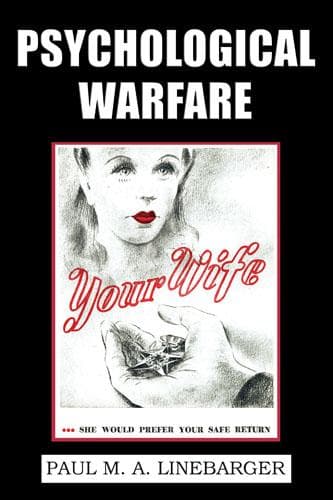
Psychological WarfareLinebarger, Paul Myron Anthony
History
Psychological Warfare
Linebarger, Paul Myron Anthony
Psychological warfare
[20] Chicago, 1946. The discussion of what censorship authorities
regarded as propaganda material possessing value for the enemy, of the
wartime OC-OWI relationship, and of censorship of short-wave broadcasts
are of particular interest to the student of psychological warfare.
[21] In a somewhat different context, it is interesting to note that
Chinese Protestant churches, made up of Chinese church members, like to
hire ministers who mouth their Chinese with a strong American accent.
The American missionaries established the American accent as part of the
liturgical paraphernalia of Protestantism, and the Chinese preachers
trained under them accepted the American mispronouncing of Chinese as a
part of the religion. It is odd to see a church full of Chinese using
absolutely unbelievable tones while singing hymns or making appropriate
individual responses. At that, they are no funnier than the Chinese
Buddhists, who memorize long Indian sutras without understanding a
single syllable.
[22] On World War I, see Harold Lasswell's _Propaganda Technique in the
World War_, previously cited; George Creel's _How We Advertised
America_, New York and London, 1920, the very title of which is an
indication of its chief shortcoming; Lt. Col. W. Nicolai,
_Nachrichtendienst, Presse und Volksstimmung im Weltkrieg_, Berlin,
1920, by the German general staff officer chiefly responsible for staff
work on propaganda and public opinion, a very thoughtful though
prejudiced book; Heber Blankenhorn's enjoyable little classic,
_Adventures in Propaganda_, Boston, 1919 (Blankenhorn was the only
American officer to see field service in propaganda in both wars, as a
Captain in I and a Lieutenant Colonel in II); and George G. Bruntz'
scholarly monograph _Allied Propaganda and the Collapse of the German
Empire_ in 1918, Stanford, 1938. Readers desiring further references
should consult the bibliographies by Lasswell, Casey and Smith, cited
above.
[23] Colonel Nicolai, book cited in footnote 1. pages 160-161.
[24] For a pro-Hitler view of the world, see Wyndham Lewis' _Hitler_,
London, 1931, if a copy is to be found. The author would probably prefer
for the book to disappear. It is an eloquent, very pro-Nazi book,
putting the Hitlerite terminology into the English language and--what is
more important--infusing into the clumsy German pattern of
thinking-and-feeling a lightness of touch which makes Naziism more
palatable. The book converted no one in its time, and is not apt to do
harm at this late date; but it will make the English-reading reader
understand some of the novelty, the revolutionary freshness, the bold
unorthodoxy which made millions of people turn to Hitlerism as an escape
from the humdrum heartbreak of Weimar Germany. Much of the book is
devoted to the problem of power--street-fighting, mass demonstrations,
slogans, symbolisms--which so fascinated the Nazis.
Public-domain text, read in full here on John Shaqi.
Reviews
Reviews
No reviews yet
Be the first to share your thoughts on this work.
Elsewhere in the archive
Join the Discussion
Join the discussion
Sign in to leave a comment or review.
Sign InorCreate an account