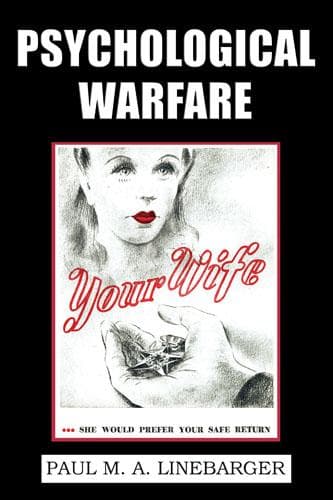
Psychological WarfareLinebarger, Paul Myron Anthony
History
Psychological Warfare
Linebarger, Paul Myron Anthony
Psychological warfare
[29] The bibliographies are cited above, on page 38. The journal comes
out, as its title indicates, four times a year; it is published by the
School of Public and International Affairs, Princeton University,
Princeton, N. J. Every major library has it. The review section provides
a good survey of new writing in the field. Journals such as _The
American Political Science Review_, _The Annals of the American Academy
of Political and Social Science_, _The Infantry Journal_, and _The
American Historical Review_ often have significant articles or book
reviews in this field. _International Affairs_ (Royal Institute for
International Affairs, London) has excellent reviews of books arranged
by geographic subheads. Opinion and propaganda topics are usually lumped
together in academic studies; material on the one is apt to lead to the
other.
[30] San Tzu Ching, translated and annotated by Herbert A. Giles,
Shanghai, 1910, pages 2 and 3. The translation quoted is not by Giles.
[31] On the transmitting side, nothing could be more ruinous than mere
translation, the more literal the worse, of a single basic broadcast for
all audiences irrespective of language or culture. For the text of war
communiqués or of official documents, this is permissible, but for news
or feature broadcasts, few things could be worse. It is not possible to
translate subtle psychological appeals embedded in news or commentary;
such materials by their nature must follow forms acceptable to the
audience, building up confidence with familiar allusions and creating a
sense of "we-ness" between the actual announcer and his listeners.
Equivalents can be worked out. The same basic policies can be
transposed. The same source of news and intelligence can be exploited.
But the actual program cannot be translated verbatim from one language
to another; it must be transposed not only from one language but from
one culture to another.
[32] Free advertisement.
[33] Bad news about his side is not necessarily the only kind of bad
news for the enemy to know. Gloomy news about our side can harm the
enemy listener if his government is running a propaganda campaign to
raise production, promote thrift, etc., by claiming things are worse on
_their_ side. In such a case, good news about us would be good for him.
News must be fitted to the propaganda plan and to the propaganda
situation.
[34] Walter Lippmann's book, _Public Opinion_, was first published in
New York in 1922 but it is still clean-cut as a basic statement of the
problems of public opinion. The author's own life as a commentator is
remarkable in fulfilling the mission which he implicitly set himself
when writing about public opinion: the job of lifting issues into
emotional and psychological contexts in which the resulting judgment
will be based on socially sound factors.
Public-domain text, read in full here on John Shaqi.
Reviews
Reviews
No reviews yet
Be the first to share your thoughts on this work.
Elsewhere in the archive
Join the Discussion
Join the discussion
Sign in to leave a comment or review.
Sign InorCreate an account