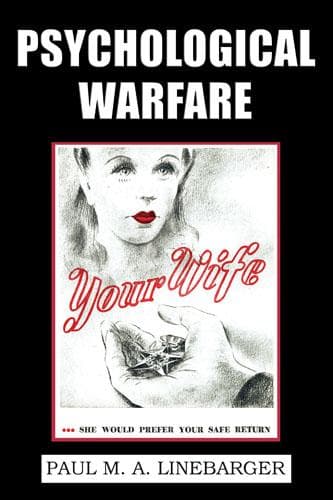
Psychological WarfareLinebarger, Paul Myron Anthony
History
Psychological Warfare
Linebarger, Paul Myron Anthony
Psychological warfare
[25] See Carl J. Friedrich, _The New Belief in the Common Man_,
Brattleboro (Vermont), 1945, chapter III, "Independence of Thought and
Propaganda," pp. 81-120, for a cogent discussion of this mentality. The
present author, in _Government in Republican China_, New York, 1938, pp.
18-23, describes in epitome the method whereby the ancient Confucian
leadership of China, while propaganda-conscious, used ideology as an
economical, stable method of control and avoided its maleficent
features. In one of the few poorly argued passages of a great work,
Arnold J. Toynbee overlooks this peculiar characteristic of Confucianism
and merely equates the Confucian dogma with those of other "universal
churches" (_A Study of History_, London, 1939, vol. V, especially pages
654-5).
[26] People's Commissariat of Justice of the U.S.S.R., _Report of Court
Proceedings in the Case of the Anti-Soviet Trotzkyite Centre ...,
Verbatim Report_, Moscow, 1937, page 111. These trials were themselves
propaganda; in this particular instance, propaganda of a rather poor
order, since they failed to convince the foreign public and presumably
persuaded only those portions of the Russian public who were so gullible
that they needed no further persuading. For a brilliant illumination of
them in terms of a readable novel, see Arthur Koestler, _Darkness at
Noon_, New York, 1941; the same author also has a book of essays on the
totalitarian mentality under the rather fancy title, _The Yogi and the
Commissar_, New York, 1945. On the same subject, see Louis Fischer's
_Men and Politics_, New York, 1942.
[27] This document establishing the COI, along with the other major
documents pertaining to American psychological warfare, may be found in
J. P. Warburg's book cited above, _Unwritten Treaty_.
[28] In the course of a routine day of work on overseas propaganda in
1942, the author, who was then in SSG of MIS, found it necessary to get
in touch with Military Intelligence proper, Naval Intelligence, the
State Department, the office of the Assistant to the President, the
Office of Facts and Figures, the British Political Warfare group (which
was vainly seeking its American opposite number), the Office of Civilian
Defense, the Research and Analysis Branch of the office of the
Coordinator of Information, the office of the Librarian of Congress, the
Foreign Information Service, and the Department of Agriculture. Each of
these either operated propaganda, or had policy or intelligence
contributions to make. The Board of Economic Warfare naturally came into
the field too. This was during a period of German and Japanese
victories, so that even if propaganda had been coordinated, it probably
would not have been much more effective than it was. From what could be
figured out later, no real harm was done at this time. Nor was much
achieved.
Public-domain text, read in full here on John Shaqi.
Reviews
Reviews
No reviews yet
Be the first to share your thoughts on this work.
Elsewhere in the archive
Join the Discussion
Join the discussion
Sign in to leave a comment or review.
Sign InorCreate an account