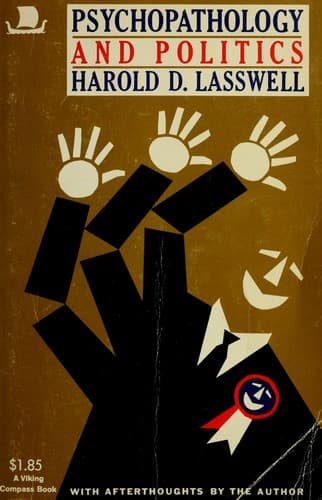
Psychopathology and politicsLasswell, Harold D. (Harold Dwight)
Science
Psychopathology and politics
Lasswell, Harold D. (Harold Dwight)
Personality and politics; Political science; Psychoanalysis; Psychology, Pathological
So keen was his preoccupation with self-mastery that he resented
every effort to influence him, and acted with unnecessary strictness
in dealing with private lumbermen. He was often deprived of human
relationships during his days in the field, and gradually his mind
became more and more enmeshed in morbid reflections about himself.
His mind simply refused to concentrate on the technical volumes which
he had brought with him to improve the solitude. Reveries which had
been slowly germinating on the periphery of his attention now began to
foliate. K had always wondered why his mother burned those little bits
of paper. It dawned on him one day that she might really have died of
tuberculosis, and that he must therefore be predisposed toward that
disease. Early in his high-school days, he had begun deep-breathing
exercises, though he had never freely admitted to himself or anybody
else what lay behind it. He always gave the usual account of his
mother’s death to insurance examiners, smothering his doubts in
affirmation.
This was his state of mind when America entered the war. He found
himself saying that since he was going to die anyhow from a loathsome
disease, he might as well die at once and get it over with. Enlisting
without delay, he sought to reach an exposed position as rapidly as
he could. But the government had different ideas, and assigned him to
a branch of the service where his technical skill would prove useful.
In his disappointment, all the old feelings of inadequacy returned.
Interviewed by an officer he floundered and stumbled, neglecting
to report essential facts about his training and experience. The
accidental intervention of an acquaintance straightened out the matter,
and secured the authority to which his record entitled him. At first
he was very much embarrassed in the company of lumberjacks, but his
behavior never showed his confusion. His actual record was, as usual,
excellent, and his conscientious efficiency won the indorsement of
everybody who knew him.
K married a rather dominating school-teacher whom he had known for some
time. When things went badly, as they often did, he was partially
impotent, and also showed the phenomenon which has been christened
“Sunday neurosis.” Every Sunday afternoon when he was at home he would
find himself assailed by deep depression, and would weep quietly to
himself.[43] In spite of these neurotic troubles, K was able to make
an important place for himself inside a bureaucracy, when he came back
from the army.
Public-domain text, read in full here on John Shaqi.
Reviews
Reviews
No reviews yet
Be the first to share your thoughts on this work.
Elsewhere in the archive
Join the Discussion
Join the discussion
Sign in to leave a comment or review.
Sign InorCreate an account