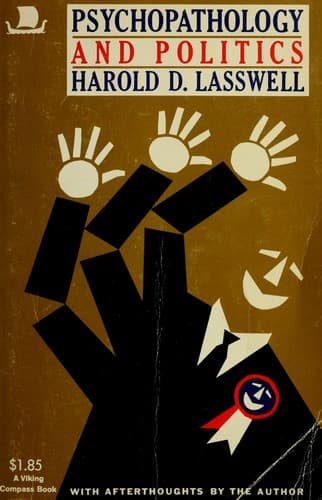
Psychopathology and politicsLasswell, Harold D. (Harold Dwight)
Science
Psychopathology and politics
Lasswell, Harold D. (Harold Dwight)
Personality and politics; Political science; Psychoanalysis; Psychology, Pathological
From one point of view, K’s character may be summed up by saying that
his overscrupulous performance of duty was an elaborate effort to
demonstrate his potency, and that his longing for danger came at a
time when he was willing to surrender the struggle. K’s morbid moods
and persistent feelings of inadequacy are self-imposed penalties for
his hostilities against the environment. He possessed very powerful
aggressive drives which were partly expressed in the adoption of a
self-ideal which was far more ambitious than anything deemed feasible
by the family. His narcissism was such that he was prevented from
viewing himself as an object, and from modifying his demands upon the
world for recognition, and upon himself for production, until these
demands bore a closer relationship to his own skills and opportunities.
The basis for his obsessive scrupulousness was laid during early
childhood, when he was torn between father and mother-loyalties, and
acted out within his own nature the clashes that occurred between
them. His strong mother-identification is shown by his belief that he
suffered from her diseases, and would die from tuberculosis as she had
died. He preferred death to a reduction in his demands upon himself
and the world. Such a reaction has in it the primitive demand of the
child to treat the world as controllable at will by the omnipotent
fantasy. His genital difficulties testify to the intensity of the
castration conflict, and show the passive-oral regression. K deeply
resented having to adjust to the world at all. His capacity for hard
work was achieved against high resistance, and in part had the value of
a penance. Thus when workless days came around, he was always ill at
ease, and sometimes showed the spells of weeping on Sunday afternoons.
To work was to prove his potency, and to supply a ritual substitute
for and defense against his antisocial impulses. He was unable to
emancipate himself very far from the reactions of the people in his
immediate environment.
* * * * *
As a class the administrators differ from the agitators by the
displacement of their affects upon less remote and abstract objects.
In the case of one important group this failure to achieve abstract
objects is due to excessive preoccupation with specific individuals in
the family circle, and to the correlative difficulty of defining the
rôle of the self. Putting agitator A at one end of the scale, we may
place administrator K or H near the other. Agitator B was less able
to displace than A, as shown by the more personal character of the
reforms which interested him. K or H were so concerned about definite
people, and about their own failures in relation to many of them, that
emancipation was unattainable.
Public-domain text, read in full here on John Shaqi.
Reviews
Reviews
No reviews yet
Be the first to share your thoughts on this work.
Elsewhere in the archive
Join the Discussion
Join the discussion
Sign in to leave a comment or review.
Sign InorCreate an account