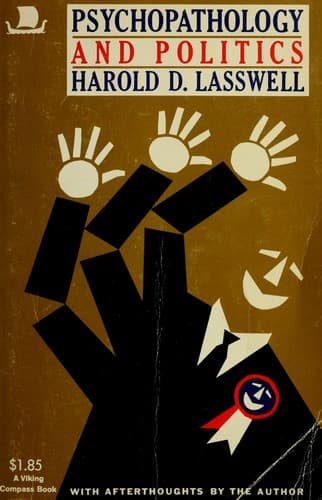
Psychopathology and politicsLasswell, Harold D. (Harold Dwight)
Science
Psychopathology and politics
Lasswell, Harold D. (Harold Dwight)
Personality and politics; Political science; Psychoanalysis; Psychology, Pathological
As a hypothetical construction from these “marginal” cases, we may
suggest that another group of administrators is recruited from among
those who have passed smoothly through their developmental crises. They
have not overrepressed powerful hostilities, but either sublimated
these drives, or expressed them boldly in the intimate circle. They
display an impersonal interest in the task of organization itself,
and assert themselves with firmness, though not with overemphasis,
in professional and in intimate life. Their lack of interest in
abstractions is due to the fact that they have never needed them as
a means of dealing with their emotional problems. They can take or
leave general ideas without using them to arouse widespread affective
responses from the public. Tied neither to abstractions nor to
particular people, they are able to deal with both in a context of
human relations, impersonally conceived. Their affects flow freely;
they are not affectless, but affectively adjusted. Very original and
overdriving administrators seem to show a fundamental pattern which
coincides with that of the agitators; the differences in specific
development are principally due to the cultural patterns available for
identification at critical phases of growth.
CHAPTER IX
POLITICAL CONVICTIONS
Political prejudices, preferences, and creeds are often formulated in
highly rational form, but they are grown in highly irrational ways.
When they are seen against the developmental history of the person,
they take on meanings which are quite different from the phrases in
which they are put.
To begin, almost at random, with L. He believes that the United States
ought to join the League of Nations and that our government ought to
lead the world toward conciliation and peace. He is a Republican in
party preference, and possesses well-rationalized judgments on a number
of public questions. It is for none of these reasons that his history
is of special value to the political scientist. What his intimate
history does disclose is an exact parallelism between his political
opinions and those of his father and mother, and, besides that, a
conscious anxiety on his part to conform to the parental pattern of
belief and occupation. He has a strange premonition that if he goes his
own way something terrible will happen. Thus L is not only a simple
conformer, but a compulsive conformer.
Public-domain text, read in full here on John Shaqi.
Reviews
Reviews
No reviews yet
Be the first to share your thoughts on this work.
Elsewhere in the archive
Join the Discussion
Join the discussion
Sign in to leave a comment or review.
Sign InorCreate an account