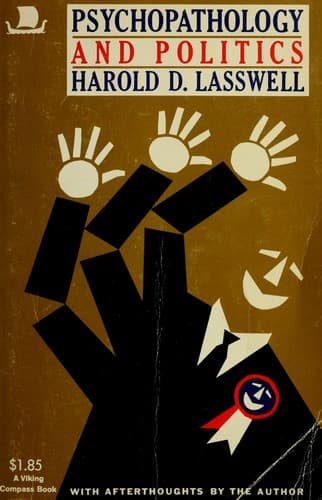
Psychopathology and politicsLasswell, Harold D. (Harold Dwight)
Science
Psychopathology and politics
Lasswell, Harold D. (Harold Dwight)
Personality and politics; Political science; Psychoanalysis; Psychology, Pathological
In Germany the social scientists were so occupied with the _Streit
um Marx_ and the triumphs of the comparative historical school that
a comparative morphology of subjective histories, if one may indulge
the phrase, did not arise. The prodigious influence of Kant in the
direction of multiplying epistemological subtleties stereotyped a
penchant for high abstraction in the consideration of psychological
phenomena. The great successes of the physical sciences seemed to
rest upon the ruthless division and re-division of phenomena until
they became amenable to manipulation and control. The combination of
Kantian acuteness with scientific atomism was capable of producing the
extremes of physiological psychology and the obscurantist revulsion
against submitting the sacred mystery of personality to the coarse
indignity of exact investigation. Curiously enough, the modern era of
personality study was introduced as a protest against the laboratory
emphasis, and meant a capitulation to the spirit of scientific
irreverance. Personalities could be compared and typologized. The
pioneer was Dilthey, the philosophic historian; but neither he nor
those who followed him collected and published actual accounts of
intimate subjective experiences. Sociological overemphasis on the group
was only partially compensated in Simmel’s theoretical exposition
of individuality, but there was no happy synthesis of category
and fact in his work. The field ethnologists neglected to assemble
autobiographical accounts, and only the fine sensibilities of Vierkandt
made possible the utilization of fragments for the sake of comparing
the inner life of primitive man with that of modern man, a task which
was performed with rather more subtlety than by the French. The early
social psychological impetus of Lazarus and Steindhal produced vast
collections of folk-lore materials, but the task of threading folk lore
and folk ways onto the developmental history of representative persons
remained undone.
The great innovator in the subjective field was Freud. His book on
dreams is one of the most unique autobiographies in history, and his
publications set the pace for those who wanted to record the actual
outpourings of the unrestrained human mind. Here at last was a truly
scientific spirit who recorded everything of which the human mind
was capable, and looked at it critically in the hope of finding the
laws of mental life. He broke through the irrelevant barriers of
conventionality and brought dark continents of data into the light of
inquiry. He proposed theories which were supposed to be tested by the
data, and devised a special procedure for securing data.
Public-domain text, read in full here on John Shaqi.
Reviews
Reviews
No reviews yet
Be the first to share your thoughts on this work.
Join the Discussion
Join the discussion
Sign in to leave a comment or review.
Sign InorCreate an account