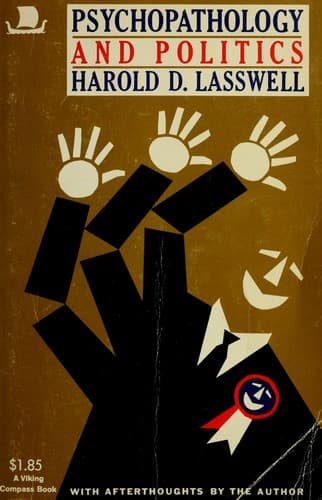
Psychopathology and politicsLasswell, Harold D. (Harold Dwight)
Science
Psychopathology and politics
Lasswell, Harold D. (Harold Dwight)
Personality and politics; Political science; Psychoanalysis; Psychology, Pathological
A father-hatred (due to unrequited love) of remarkable intensity was
the basis of another career which Stekel examined. O was the young
leader of an anarchist band whose anarchism went beyond precept to
dramatic practice. O had his companions conduct some holdups to get
money to start an anarchist paper. O was an illegitimate child who was
brought up and spoiled by an overindulgent mother. When he realized
that he had a father who was still living, but whose identity was never
divulged, his anger boiled up against his mother upon whose affections
he no longer had monopolistic claim, and against his unknown father,
who refused him love and distinction. For he had no doubt that his
father was a rich and important personage. O displaced much of his
animosity on to remote, abstract symbols of authority, like kings
and capitalists, and devoted himself to destroying them. Much of his
affection was likewise displaced upon abstract ideals of a fatherless
fraternal society, living together without coercion. His sadistic
impulses were by no means entirely sublimated upon remote goals and
harmonious means, for he led his companions on common robberies. O
threw a thick mantle of rationalization over his murderous impulses
and his criminal acts, seeking to justify coercion in the name of a
coercionless ideal which could only be laboriously achieved in the
world.
It is the history of such cases, in which the emotions are peculiarly
intense, which leads one to conclude that political assassins have
hated their fathers with unusual bitterness. E. J. Kempf remarks in his
psychopathology, after reviewing the historical evidence in the cases
of Guiteau, the assassin of President Garfield, and of Booth, the
assassin of President Lincoln, as follows:
The writer does not hold that every case of severe affective
repression in youth, due to the father’s hatred or a father
equivalent’s, will lead finally to a parricidal or treasonable
compulsion. It is only held that such affective repressions produce
a revolutionary character which, if given an appropriate repressive
setting during maturity, will then converge upon the parricidal
act. Without the rather specific type of affective repression in
his youth, he would be invulnerable to parricidal suggestions later
on.[44]
Public-domain text, read in full here on John Shaqi.
Reviews
Reviews
No reviews yet
Be the first to share your thoughts on this work.
Elsewhere in the archive
Join the Discussion
Join the discussion
Sign in to leave a comment or review.
Sign InorCreate an account