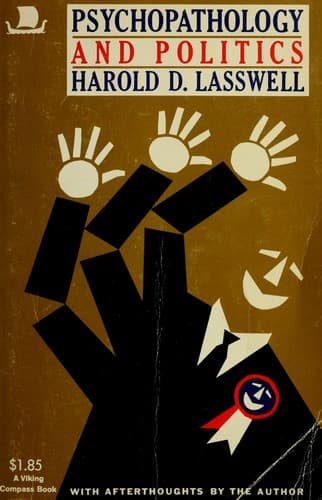
Psychopathology and politicsLasswell, Harold D. (Harold Dwight)
Science
Psychopathology and politics
Lasswell, Harold D. (Harold Dwight)
Personality and politics; Political science; Psychoanalysis; Psychology, Pathological
Illegitimate children, especially when the identity of their father is
undisclosed, carry with them the perpetual query, “Who is my father?”
Indeed, the fantasy of belonging to other parents than those physically
in the family is sufficiently widespread as a disguised hostile reverie
against the actual parents to enable everyone to appreciate in some
measure the mental state of the illegitimate child. “My father may be
rich and powerful.” “My father may be an aristocrat of distinguished
lineage, and he is denying me all my just privileges.” Such fantasies
are taken up and spun out in the reveries of the victim. There is a
presumption that those who suffer from this kind of social inferiority
are especially numerous among those who commit acts of political
violence, as Lombroso held.
P accepted violence, but of a different kind. P is a patriot who proved
his patriotism by volunteering in the late war during the course of
which he was distinguished for bravery in action. His deepest longing
is for war to come again. He is in favor of an aggressive foreign
policy since it increases the chances of war, and war he would welcome
again as he welcomed it before.
P has a younger brother and an older sister. His mother died when he
was six and his relations have been strained with his stepmother, who
entered the family shortly afterward. His father was a very successful
professional man.
P began to fall behind in his schoolwork when he was about seven
years old. This brought him into disrepute at home, for his previous
promise led everyone to expect much from him, and the change seemed
to prove that he was “lazy.” The family has nagged him ever after,
hoping to stimulate him to work harder. Just why he failed to continue
to cope successfully with the demands of school becomes fairly clear
when his reminiscences of the period are recovered. He had loved his
second-grade teacher and had been her special favorite, and both his
marks and his enthusiasm were high. The third-grade teacher impressed
him as stern and cruel, and he soon began to despise the sight of her.
The boy’s work began to crumble, for his mind was full of hostile
fancies about his new teacher, and of yearning fancies for the teacher
whom he had just lost.
Public-domain text, read in full here on John Shaqi.
Reviews
Reviews
No reviews yet
Be the first to share your thoughts on this work.
Elsewhere in the archive
Join the Discussion
Join the discussion
Sign in to leave a comment or review.
Sign InorCreate an account