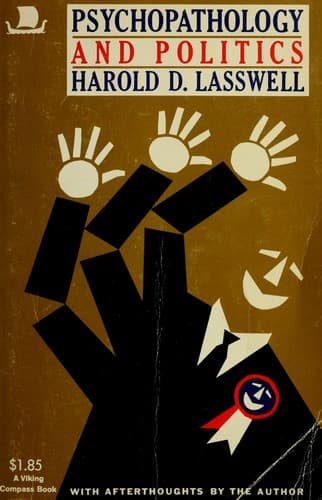
Psychopathology and politicsLasswell, Harold D. (Harold Dwight)
Science
Psychopathology and politics
Lasswell, Harold D. (Harold Dwight)
Personality and politics; Political science; Psychoanalysis; Psychology, Pathological
His emotional life was further disturbed about this time by the loss
of his nurse. P’s stepmother discharged her as soon as she came. Now
the nurse was the lad’s main love, for his own mother had been ill
for some years before her death. The nurse’s presence gave the child
that stable reassurance which is so necessary if the mind of the child
is to be kept free from morbid fears. In P’s case, there were strong
reasons why this reassurance was necessary. An insane man lived across
the street and terrified the passers-by by screaming at everyone who
passed. Shortly after his mother’s death P went under ether for a minor
operation and was terrified that he would die. The fear of suffocation
reappeared in dreams and nightmares, and he was very timid about
learning to swim.
The stepmother was a disturbing element as a strange and unknown
quantity in the environment, and a competitor for the affection of the
father. When she discharged the nurse, P thought of her as a malignant
influence. His troubles at school were exaggerated by his home changes,
and his mind became preoccupied with fantasies directed against his
stepmother, or some substitute.
P’s father was ambitious for the boy. P remembers him as quick to
reprove and slow to praise. He dreamed of his father’s death, and of
seeing his father in an accident. But his manifest attitude was one of
respectful affection. No matter what happened in the home, he excused
his father by reflecting that the stepmother was to blame. However, on
the deeper level, it appeared that he held his father accountable for
the death of his mother and the disappearance of his nurse.
At school P was popular because of his good physique and his docile
nature. But his studies came hard. Having failed on college-entrance
tests, P bolted and joined the army. The war came along just in time
to give him a dignified retreat from an unbearable personal situation.
He hoped that his father would think about him with pride. He was
bitterly self-accusatory because of his failure to “make good,” and
felt a strong unconscious need of punishment. Under these conditions he
entered army life with enthusiasm, and made a fine record for personal
courage.
Once the war was over, his troubles began again. He succeeded in
entering college, but college felt like a nursery. He felt that his
army experience sophisticated him above schoolboy tasks and chatter.
All his old worries returned, complicated by his longing for a new war.
He had a long series of difficulties in his occupational life.
Public-domain text, read in full here on John Shaqi.
Reviews
Reviews
No reviews yet
Be the first to share your thoughts on this work.
Elsewhere in the archive
Join the Discussion
Join the discussion
Sign in to leave a comment or review.
Sign InorCreate an account