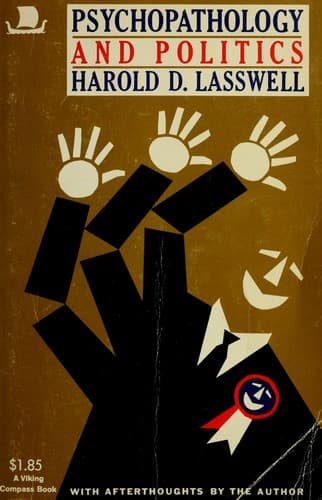
Psychopathology and politicsLasswell, Harold D. (Harold Dwight)
Science
Psychopathology and politics
Lasswell, Harold D. (Harold Dwight)
Personality and politics; Political science; Psychoanalysis; Psychology, Pathological
Political movements derive their vitality from the displacement of
private affects upon public objects. The intensive scrutiny of the
individual by psychopathological methods discloses the prime importance
of hitherto-neglected motives in the determination of political traits
and beliefs. The adult who is studied at any given cross-section of
his career is the product of a long and gradual development in the
course of which many of his motivations fail to modify according to the
demands of unfolding reality. The adult is left with an impulse life
which is but partially integrated to adulthood. Primitive psychological
structures continue in more or less disguised form to control his
thought and effort.
The state is a symbol of authority, and as such is the legatee of
attitudes which have been organized in the life of the individual
within the intimate interpersonal sphere of the home and friendship
group. At one phase of childhood development the wisdom and might of
the physical symbol of authority, typically the father, is enormously
exaggerated by the child. Eder traces the significance of this for the
state in the following words:
What occurs as we come more in touch with the external world, when
the principle of reality develops, is the finding of surrogates for
this ideal father. We discover that the parent is not all-wise,
all-powerful, all-good, but we still need to find persons or
abstractions upon which we can distribute these and similar
attributes. By a process of fission these feelings are displaced
on to and may be distributed among a number of surrogates. The
surrogates may be persons, animals, things or abstract ideas; the
headmaster, the dog, the rabbit, the Empire, the Aryan race, or any
particular “ism.”
He comments that it is upon this self-ideal that is formed the
possibility of leadership, of leaders, and of the supreme leader,
who is the one capable of doing all that the child once thought the
physical father could do. The unconscious motivation is reflected in
the sober formula of Blackstone, “The sovereign is not only incapable
of doing wrong, but even of thinking wrong: he can never mean to do an
improper thing; in him is no folly or weakness.”[45]
There is very deep meaning in the phrase of Paley’s that “a family
contains the rudiments of an empire.” The family experience organizes
very powerful drives in successive levels of integration, and these
primitive attitudes are often called into play as the unobserved
partners of rational reactions. To choose another extract from Eder:
Public-domain text, read in full here on John Shaqi.
Reviews
Reviews
No reviews yet
Be the first to share your thoughts on this work.
Elsewhere in the archive
Join the Discussion
Join the discussion
Sign in to leave a comment or review.
Sign InorCreate an account