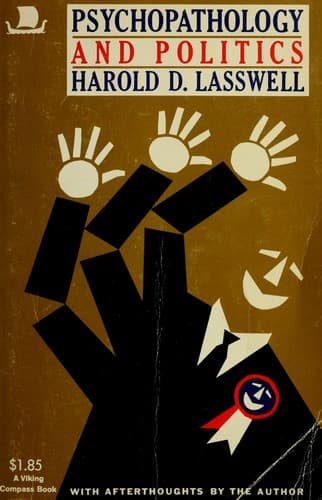
Psychopathology and politicsLasswell, Harold D. (Harold Dwight)
Science
Psychopathology and politics
Lasswell, Harold D. (Harold Dwight)
Personality and politics; Political science; Psychoanalysis; Psychology, Pathological
Defiance of authority is defiance of the introjected conscience, and
involves a measure of self-punishment. We have seen how a powerful need
for self-punishment is the stuff out of which martyrs and sensational
failures are made; but of more general importance is the rôle of
the sense of guilt in supporting the _status quo_. Deviation from
accepted patterns becomes equivalent to sin, and the conscience visits
discomforts upon those who dare to innovate. Radical ideas become
“sacrilegious” and “disloyal” in the view of the primitive conscience,
for they tend to represent more than a limited defiance of authority.
They put the whole structure of the personality under strain. The
childish conscience is easily intimidated into preserving order on
slight provocation; it knows little of the capacity to consider the
piecemeal reconstruction of values. “Radicalism” is felt as a challenge
to the whole system of resistances which are binding down the illicit
impulses of the personality, rather than as an opportunity for detached
consideration of the relation of the self to the rest of reality. There
is little boldness in political thinking which is not accompanied by an
overdose of defiance, for even those who succeed in breaking through
the intimidations of their infantile consciences must often succumb in
some measure and “pay out.” Much of the struggle, the fearful _Sturm
und Drang_ of the emancipated thinker, is his unconscious tribute to
the exactions of the tribunal which he erected within himself at an
early age, and which continues to treat innovation as _ipso facto_
dangerous. The non-obsessive thinker is one who can coolly contemplate
revisions in the relations of man to reality unperturbed by his
antiquated conscience. Often readjustments of human affairs which are
proposed are driven to absurdity because the original mind is compelled
to transform his mere departure from the conventional into a defiance
of conventionality. When one perceives the operation of this powerful
self-punishment drive, and the secondary efforts to free one’s self
from feelings of guilt for defying the authorized order, it is possible
to remain understandingly tolerant of the eccentricities of creative
minds. To put the point a bit sharply, it is safe to say that the
adult mind is only partly adult; the conscience may be four years old.
The conscience, the introjected nursemaid, reacts undiscriminatingly to
change, and construes it as rebellion.
The organization of motives which occurs in adolescence possesses
direct significance for the interpretation of political interests.
Public-domain text, read in full here on John Shaqi.
Reviews
Reviews
No reviews yet
Be the first to share your thoughts on this work.
Elsewhere in the archive
Join the Discussion
Join the discussion
Sign in to leave a comment or review.
Sign InorCreate an account