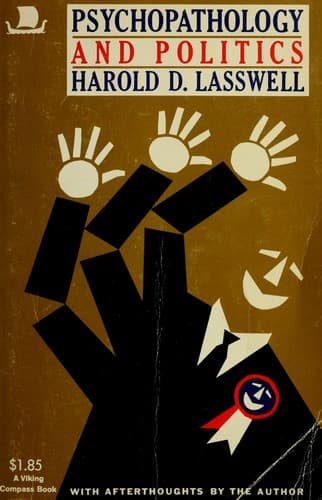
Psychopathology and politicsLasswell, Harold D. (Harold Dwight)
Science
Psychopathology and politics
Lasswell, Harold D. (Harold Dwight)
Personality and politics; Political science; Psychoanalysis; Psychology, Pathological
Political life seems to sublimate many homosexual trends. Politicians
characteristically work together in little cliques and clubs, and many
of them show marked difficulties in reaching a stable heterosexual
adjustment. In military life, when men are thrown together under
intimate conditions, the sublimations often break down and the
homosexual drives find direct expression. A German general has gone so
far as to declare that one reason why Germany lost the war was that
the command was shot through with jealousies growing out of homosexual
rivalry. Dr. K. G. Heimsoth has prepared a manuscript describing the
rôle of homosexuality in the volunteer forces which continued to
operate against the Poles and the communists after the war. In the case
of certain leaders, at least, the reputation for overt homosexuality
was no handicap; indeed, the reverse seemed to be true. Franz Alexander
has suggested that one reason why homosexuality is viewed with contempt
in modern life is the vague sense that complex cultural achievement
depends on an inhibited sexuality, and that direct gratification
tends to dissolve society into self-satisfied pairs and cliques. The
observations of Heimsoth throw some doubt on the wisdom of this “vague
sense.”[48] The prominence of alcoholism and promiscuity among like-sex
groups has often been observed, and both indulgences appear to be
closely connected with homosexual impulses.[49]
Political crises are complicated by the concurrent reactivation
of specific primitive impulses. War is the classical situation in
which the elementary psychological structures are no longer held in
subordination to complex reactions. The acts of cruelty and lust which
are inseparably connected with war have disclosed vividly to all who
care to see the narrow margin which separates the social from the
asocial nature of man. The excesses of heroism and abnegation are alike
primitive in their manifestations, and show that all the primitive
psychological structures are not antisocial, but asocial, and may often
function on behalf of human solidarity.[50]
Public-domain text, read in full here on John Shaqi.
Reviews
Reviews
No reviews yet
Be the first to share your thoughts on this work.
Elsewhere in the archive
Join the Discussion
Join the discussion
Sign in to leave a comment or review.
Sign InorCreate an account