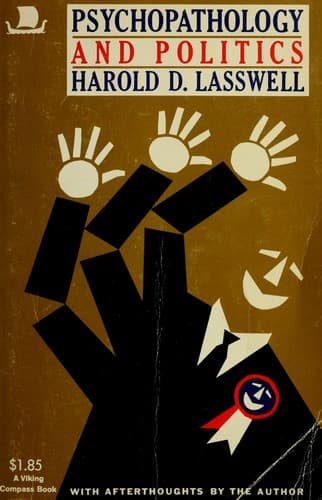
Psychopathology and politicsLasswell, Harold D. (Harold Dwight)
Science
Psychopathology and politics
Lasswell, Harold D. (Harold Dwight)
Personality and politics; Political science; Psychoanalysis; Psychology, Pathological
Why does society become demoralized in the process of revolution? Why
should a change in the political procedures of the community unleash
such excesses in behavior? Reflection might lead one to suppose
that since important decisions are in process of being made, calm
deliberation would characterize society. Evidently a reactivating
process is at work here; there is a regressive tendency to reawaken
primitive sadism and lust. The conspicuous disproportionality between
the problem and the behavior necessitates an explanation in such
terms. Federn published a sketch of the psychology of revolution in
his pamphlet _Die vaterlose Gesellschaft_ in 1919. When the ruler
falls, the unconscious triumphantly interprets this as a release from
all constraint, and the individuals in the community who possess the
least solidified personality structures are compulsively driven to acts
of theft and violence. An interview which Federn gave to Edgar Ansel
Mowrer in 1927 on the occasion of the Vienna riots reviews in somewhat
popular form some of his conceptions.
Vienna, Austria, July 20.--“Distrust of father was the chief
cause of the Vienna riot,” said Paul Federn, onetime president of
the Psychoanalytical Society. From a psychoanalytical standpoint
all authority is the father, and this formerly for Austria was
incorporated in the imposing figure of Emperor Franz Josef. But
during the war the father deceived and maltreated his children, and
only the material preoccupations of life and the joyous outburst
when at the close of the war the old authority broke asunder
prevented Austria from having a revolution then.
The state again built up the old ruling caste and began to hope for
restoration, and therefore an abyss opened between Vienna, which
under socialist leadership is trying to replace the traditional
father principle by a new brotherhood, and the Austrian federal
state, which had returned to a modified father idea. Trust in
father is the child’s deepest instinct. Vienna first respected the
Austrian republic, but gradually this belief was undermined by the
continual misery, by newspapers preaching fanaticism and by legal
decisions which virtually destroyed the people’s belief in the new
father’s justice.
Accordingly there occurred a spontaneous manifestation which
unconsciously drove the disillusioned and furious children to
destroy precisely those things on which the paternal authority
seems to rest--namely, records and legal documents.
Public-domain text, read in full here on John Shaqi.
Reviews
Reviews
No reviews yet
Be the first to share your thoughts on this work.
Elsewhere in the archive
Join the Discussion
Join the discussion
Sign in to leave a comment or review.
Sign InorCreate an account