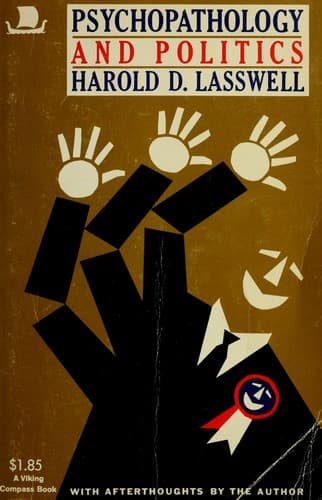
Psychopathology and politicsLasswell, Harold D. (Harold Dwight)
Science
Psychopathology and politics
Lasswell, Harold D. (Harold Dwight)
Personality and politics; Political science; Psychoanalysis; Psychology, Pathological
Although the dynamic of politics is to be sought in the tension level
of the individuals in society, it is to be taken for granted that
all individual tensions are not removed by political symbolization
and exertion. When Y hits a foreman in the jaw whom he imagines has
insulted him, Y is relieving his tensions. But if the act is construed
by him as a personal affair with the foreman, the act is not political.
Political acts are joint acts; they depend upon emotional bonds.
Now people who act together get emotionally bound together. This
process of becoming emotionally bound is dependent on no conscious
process. Freud said that he was made clearly aware of the emotional
factor in human relations by observing that those who work together
extend their contact to dining and relaxing together. Those with
whom we work are endowed with rich meanings on the basis of our
past experience with human beings. Since all of our motives are
going concerns within the personality, our libido is more or less
concentrated upon those with whom we come in touch. This reinforces
the perception of similarities, and supplies the dynamic for the
identification process. Even the negative identification is a tribute
to the extent to which the affective resources of the personality
become mobilized in human contact.
People who are emotionally bound together are not yet involved in a
political movement. Politics begins when they achieve a symbolic
definition of themselves in relation to demands upon the world. The
pre-political phase of the labor movement as sketched by Nexo in his
_Pelle the Conqueror_ is an able characterization of what the facts may
be. The workers had plenty of grievances against their employers, but
individuals took it out in sporadic acts of violence, and in frequent
debauchery. It was not until a new “set” of mind was achieved with the
appearance of socialist symbols, and their adoption, that the tension
found an outlet in political form. When J hits a foreman on the jaw
because the foreman swore at him, J is not acting for the working
classes; but after J becomes a socialist, his acts are symbolically
significant of the expanded personality which he possesses. Acts cease
to be merely private acts; they have become related to remote social
objects. The conception of the self has new points of reference, and
points of reference which interlock with those of others.
Public-domain text, read in full here on John Shaqi.
Reviews
Reviews
No reviews yet
Be the first to share your thoughts on this work.
Elsewhere in the archive
Join the Discussion
Join the discussion
Sign in to leave a comment or review.
Sign InorCreate an account