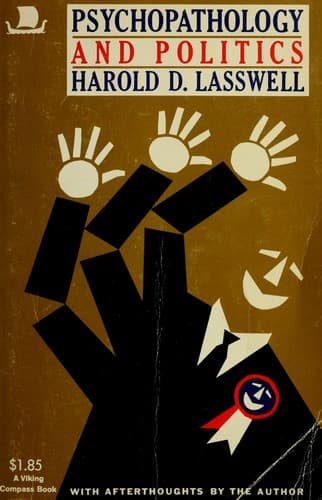
Psychopathology and politicsLasswell, Harold D. (Harold Dwight)
Science
Psychopathology and politics
Lasswell, Harold D. (Harold Dwight)
Personality and politics; Political science; Psychoanalysis; Psychology, Pathological
Political movements, then, derive their vitality from the displacement
of private affects upon public objects, and political crises are
complicated by the concurrent reactivation of specific primitive
motives. Just how does it happen that the private and primitive drives
find their way to political symbols? What are the circumstances which
favor the selection of political targets of displacement?
Political life is carried on with symbols of the whole. Politics has
to do with collective processes and public acts, and so intricate are
these processes that with the best of intentions, it is extremely
difficult to establish an unambiguous relationship between the symbols
of the whole and the processes which they are presumed to designate. To
the common run of mankind the reference points of political symbols are
remote from daily experience, though they are rendered familiar through
constant reiteration. This ambiguity of reference, combined with
universality of use, renders the words which signify parties, classes,
nations, institutions, policies, and modes of political participation
readily available for the displacement of private affects. The
manifest, rational differences of opinion become complicated by the
play of private motives until the symbol is nothing but a focus for
the cumulation of irrelevancies. Since the dialectic of politics is
conducted in terms of the whole, the private motives are readily
rationalized in terms of collective advantage.
Politics, moreover, is the sphere of conflict, and brings out all the
vanity and venom, the narcissism and aggression, of the contending
parties. It is becoming something of a commonplace that politics is
the arena of the irrational. But a more accurate description would be
that politics is the process by which the irrational bases of society
are brought out into the open. So long as the moral order functions
with spontaneous smoothness, there is no questioning the justification
of prevailing values. But when the moral order has been devalued and
called into question, a sincere and general effort may be made to find
a reflectively defensible solution of the resulting conflict. Politics
seems to be irrational because it is the only phase of collective life
in which society tries to be rational. Its very existence shows that
the moral order, with all its irrational and non-rational sanctions, is
no longer accepted without a challenge. A political difference is the
outcome of a moral crisis, and it terminates in a new moral consensus.
Politics is the transition between one unchallenged consensus and the
next. It begins in conflict and eventuates in a solution. But the
solution is not the “rationally best” solution, but the emotionally
satisfactory one. The rational and dialectical phases of politics are
subsidiary to the process of redefining an emotional consensus.
Public-domain text, read in full here on John Shaqi.
Reviews
Reviews
No reviews yet
Be the first to share your thoughts on this work.
Elsewhere in the archive
Join the Discussion
Join the discussion
Sign in to leave a comment or review.
Sign InorCreate an account