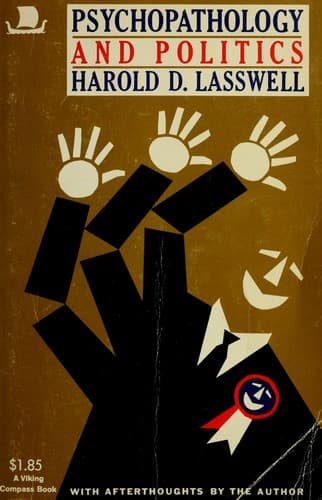
Psychopathology and politicsLasswell, Harold D. (Harold Dwight)
Science
Psychopathology and politics
Lasswell, Harold D. (Harold Dwight)
Personality and politics; Political science; Psychoanalysis; Psychology, Pathological
The psychology of personal, oratorical, and printed persuasion by means
of which support is won for particular symbols has yet to be written.
William I. Thomas long ago commented on the quasi-sexual approach
of the revivalist to the audience. Some orators are of an intimate,
sympathetic, pleading type, and resemble the attempts made by some
males to overcome the shyness of the female. Other orators fit into
the feared yet revered father-pattern; others are clowns who amuse by
releasing much repressed material; others address the socially adjusted
and disciplined level of the personality. Thus the relationship between
the speaker and the audience has its powerful emotional aspects,
which are not yet adequately explored. There are some who excel in
face-to-face relations, but who make a poor showing out on the platform.
The processes of symbolization can be studied with particular ease
when widespread and disturbing changes occur in the life-situation of
many members of society. Famine, pestilence, unemployment, high living
costs, and a catalogue of other disturbances may simultaneously produce
adjustment problems for many people. One of the first results is to
release affects from their previous objects, and to create a state of
susceptibility to proposals. All sorts of symbols are ready, or readily
invented, to refix the mobile affects. “Take it to the Lord in prayer,”
“Vote socialist,” “Down with the Jews,” “Restore pep with pepsin,” “Try
your luck on the horses”--all sorts of alternatives become available.
The prescriptions are tied up with diagnoses, and the diagnoses in
turn imply prescriptions. “A sinful world,” “Wall Street,” “a collapse
in the foreign market”--all sorts of diagnoses float about, steadily
defining and redefining the situation for the individuals affected.
Political symbols must compete with symbols from every sphere of life,
and an interesting inquiry could be made into the relative polarizing
power of political and other forms of social symbolism. Certainly the
modern world expects to fire the health commissioner rather than burn a
witch when the plague breaks out.
The competition among symbols to serve as foci of concentration for
the aroused emotions of the community leads to the survival of a small
number of master-symbols. The mobilization of the community for action
demands economy in the terms in which objectives are put. The agitation
for the control of the liquor traffic passed through many phases in
America until finally legal prohibition became the chief dividing-line.
To prohibit or not to prohibit grew into the overmastering dichotomy of
public thought.
Public-domain text, read in full here on John Shaqi.
Reviews
Reviews
No reviews yet
Be the first to share your thoughts on this work.
Elsewhere in the archive
Join the Discussion
Join the discussion
Sign in to leave a comment or review.
Sign InorCreate an account