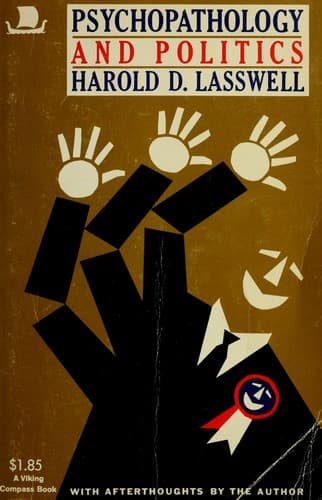
Psychopathology and politicsLasswell, Harold D. (Harold Dwight)
Science
Psychopathology and politics
Lasswell, Harold D. (Harold Dwight)
Personality and politics; Political science; Psychoanalysis; Psychology, Pathological
Symbolization thus necessitates dichotomization. The program of social
action must be couched in “yes” and “no” form if decision is to be
possible. The problem of he who would manipulate the concentration
of affect about a particular symbol is to reinforce its competitive
power by leading as many elements as possible in society to read
their private meanings into it. This reinforcement and facilitation
of the symbol involves the use of men of prestige in its advocacy,
the assimilation of special economic and other group aims, and the
invention of appeals to unconscious drives. Propaganda on behalf of a
symbol can become a powerful factor in social development because of
the flexibility in the displacement of emotion from one set of symbols
to another. There is always a rather considerable reservoir of unrest
and discontent in society, and there is nothing absolutely fixed and
predestined about the particular symbol which will have attracting
power.
The analysis of motives which are unconscious for most people, though
widespread, gives the propagandist a clue to certain nearly universal
forms of appeal. The moving pictures which have been produced by the
communist government in Russia are often remarkable examples of the use
of symbols which not only have their conscious affective dimension, but
which mobilize deep unconscious impulses. In one film, for instance, it
is the mother who suffers under tsarism and fans the flames of revolt.
Analysis has disclosed the general, and presumably universal, meaning
of the attachment to the land. The boy-child’s wish for union with the
mother, for all-embracing care and protection, undergoes some measure
of sublimation in social life. Eder remarks that it finds expression
in attachment to the earth, the land, the mother-country, home. The
_Heimweh_ of the Swiss, the pious Jew’s desire for burial in Palestine,
and a host of similar manifestations are instances of this emotional
tie whose significance for state loyalty is large.
At first sight it might appear questionable that political science
can ever profit from the disclosure of motives which are supposed to
operate in the unconscious of every human being. If these motives
are equally operative, how can they throw any light on differences
in political behavior? And are we not able to point to conditions of
a more localized and definite nature which suitably explain why the
Republican party loses out when the farmer loses his crops? Or why
there is revolution in 1918 and not in 1925?
Public-domain text, read in full here on John Shaqi.
Reviews
Reviews
No reviews yet
Be the first to share your thoughts on this work.
Elsewhere in the archive
Join the Discussion
Join the discussion
Sign in to leave a comment or review.
Sign InorCreate an account