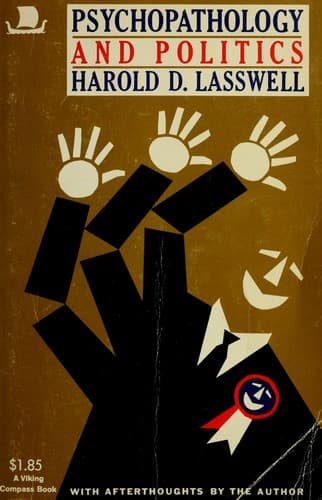
Psychopathology and politicsLasswell, Harold D. (Harold Dwight)
Science
Psychopathology and politics
Lasswell, Harold D. (Harold Dwight)
Personality and politics; Political science; Psychoanalysis; Psychology, Pathological
This complicated experience is necessary since our scale of values is
less the outcome of our dialectical than of our other experiences in
life. Values change more by the unconscious redefinition of meaning
than by rational analysis. Every contact and every procedure which
discloses new facts has its repercussions upon the matrix of partially
verbalized experience, which is the seeding ground of conscious ideas.
One peculiarity of the problem of the social scientist is that he must
establish personal contact with his material. The physical scientist
who works in a laboratory spends more time adjusting his machinery
than in making his observations, and the social scientist who works in
the field must spend more time establishing contacts than in noting
and reporting observations. What the instrumentation technique is to
the physicist, the cultivation of favorable human points of vantage is
for most social scientists. This means that the student of society, as
well as the manager of social relations, must acquire the technique
of social intercourse in unusual degree, unless he is to suffer from
serious handicaps, and his training must be directed with this in mind.
The experience of the administrator-investigator must include some
definite familiarity with all the elements which bear importantly upon
the traits and interests of the individual. This means that he must
have the most relevant material brought to his attention from the
fields of psychology, psychopathology, physiology, medicine, and social
science. Since our institutions of higher learning are poorly organized
at the present time to handle this program, thorough curricular
reconstructions will be indispensable.[59]
* * * * *
What has been said in this chapter may be passed in brief review.
Political movements derive their vitality from the displacement of
private affects upon public objects. Political crises are complicated
by the concurrent reactivation of specific primitive motives which
were organized in the early experience of the individuals concerned.
Political symbols are particularly adapted to serve as targets for
displaced affect because of their ambiguity of reference, in relation
to individual experience, and because of their general circulation.
Although the dynamic of politics is the tension level of individuals,
all tension does not produce political acts. Nor do all emotional bonds
lead to political action. Political acts depend upon the symbolization
of the discontent of the individual in terms of a more inclusive self
which champions a set of demands for social action.
Public-domain text, read in full here on John Shaqi.
Reviews
Reviews
No reviews yet
Be the first to share your thoughts on this work.
Elsewhere in the archive
Join the Discussion
Join the discussion
Sign in to leave a comment or review.
Sign InorCreate an account