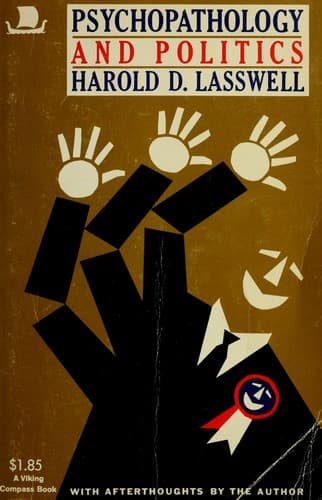
Psychopathology and politicsLasswell, Harold D. (Harold Dwight)
Science
Psychopathology and politics
Lasswell, Harold D. (Harold Dwight)
Personality and politics; Political science; Psychoanalysis; Psychology, Pathological
Preventive politics will search for the definite assessment, then, of
cultural patterns in terms of their human consequences. Some of these
human results will be deplored as “pathological,” while others will
be welcomed as “healthy.” One complicating factor is that valuable
contributions to culture are often made by men who are in other
respects pathological. Many pathological persons are constrained by
their personal difficulties to displace more or less successfully upon
remote problems, and to achieve valuable contributions to knowledge
and social policy.[56] Of course the notion of the pathological is
itself full of ambiguities. The individual who is subject to epileptic
seizures may be considered in one culture not a subnormal and diseased
person, but a supernormal person. Indeed, it may be said that society
depends upon a certain amount of pathology, in the sense that society
does not encourage the free criticism of social life, but establishes
taboos upon reflective thinking about its own presuppositions. If
the individual is pathological to the extent that he is unable to
contemplate any fact with equanimity, and to elaborate impulse through
the processes of thought, it is obvious that society does much to
nurture disease. This leads to the apparent paradox that successful
social adjustment consists in contracting the current diseases.
If “health” merely means a statistical report upon the “average,”
the scrutiny of the individual ceases to carry much meaning for the
modification of social patterns. But if “health” means something more
than “average,” the intensive study of individuals gives us a vantage
ground for the revaluation of the human consequences of cultural
patterns, and the criticism of these patterns.[57]
If the politics of prevention spreads in society, a different type of
education will become necessary for those who administer society or
think about it. This education will start from the proposition that it
takes longer to train a good social scientist than it takes to train
a good physical scientist.[58] The social administrator and social
scientist must be brought into direct contact with his material in
its most varied manifestations. He must mix with rich and poor, with
savage and civilized, with sick and well, with old and young. His
contacts must be primary and not exclusively secondary. He must have an
opportunity for prolonged self-scrutiny by the best-developed methods
of personality study, and he must laboriously achieve a capacity to
deal objectively with himself and with all others in human society.
Public-domain text, read in full here on John Shaqi.
Reviews
Reviews
No reviews yet
Be the first to share your thoughts on this work.
Elsewhere in the archive
Join the Discussion
Join the discussion
Sign in to leave a comment or review.
Sign InorCreate an account