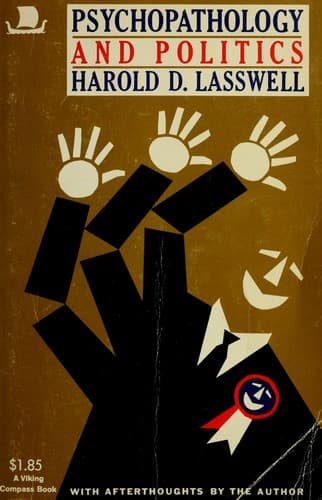
Psychopathology and politicsLasswell, Harold D. (Harold Dwight)
Science
Psychopathology and politics
Lasswell, Harold D. (Harold Dwight)
Personality and politics; Political science; Psychoanalysis; Psychology, Pathological
The psychopathologist has had the great advantage of seeing many
trends of the personality which are normally subordinated to other
trends when they have escaped from control and achieved Gargantuan
proportions. The clinical caricature throws into imposing relief the
constituent tendencies which make up the functioning person, and draws
attention to their presence and their processes. “Normality” involves
a complicated integration of many tendencies, a flexible capacity to
snap from one mood, preoccupation, and overt activity to another as
the changing demands of reality require. The pathological mind, if one
may indulge in a lame analogy, is like an automobile with its control
lever stuck in one gear: the normal mind can shift. One has a queer
feeling as one passes around the wards of a hospital for the custody
of the more seriously disordered patients that if one could assemble
the scattered parts of the mind that one could create at least a single
supermind. There in one corner is a melancholic who is stuck in the
mood of despondency; in another corner is a manic who is expansive
and elated; elsewhere is a man whose self-esteem has achieved cosmic
dimensions; in the back wards is a deteriorated mind in perpetual
repose. Every conceivable nuance of preoccupation and mood with which
we are normally familiar seems to be dissatisfied with its minor rôle
in a healthy integration, and intent upon autocratic mastery of the
mind. The clinical caricature draws attention as sharply as possible
to the components of the healthy mind. So every theory of pathological
manifestations must presently become expanded or assimilated into a
comprehensive account of human psychology.
The gross clinical material reveals the intimate interrelationships
between soma and psyche. The patient who suffers from obsessive ideas
may find relief from obsession by showing hysterical symptoms; and
hysterical symptoms may clear up, only to make way for obsessive
symptoms. “Pure pictures” are almost pure theories. The patient who is
suffering from a definite organic lesion may complicate his troubles
by “worry,” and “worry” may be one of the factors in bringing about a
physical disease picture. There is evidence that psychological factors
are among those significantly operating in such diseases as common
colds, asthma, catarrh, hay fever, hyperthyroidism, gall-bladder
trouble, gastro-intestinal ulcers, irregular menstruation, and sexual
impotence.
Fresh vitality has come into modern psychology from the clinic. The
psychopathological approach has gradually vindicated itself as more
and more of its conceptions find a permanent place in the vocabulary
of psychology and social science. Modern psychopathology is itself a
recent development, and undoubtedly the most revolutionary figure is
Sigmund Freud.
Public-domain text, read in full here on John Shaqi.
Reviews
Reviews
No reviews yet
Be the first to share your thoughts on this work.
Join the Discussion
Join the discussion
Sign in to leave a comment or review.
Sign InorCreate an account