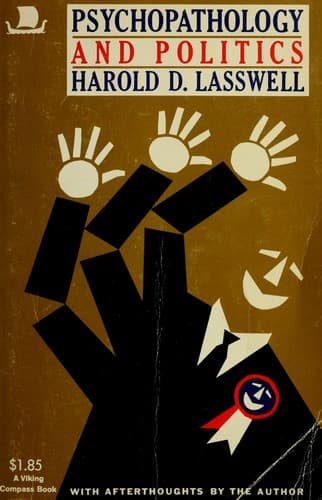
Psychopathology and politicsLasswell, Harold D. (Harold Dwight)
Science
Psychopathology and politics
Lasswell, Harold D. (Harold Dwight)
Personality and politics; Political science; Psychoanalysis; Psychology, Pathological
Third, personality events may be treated as degrees of resumption of
terminal situations of a type which have already been observed. Lying
in bed after waking up in the morning, whenever there are difficulties
to cope with, may be interpreted as a reactivation of an earlier
psychological impulse to lie still and be waited on.
Fourth, personality events may be construed as approximations to
“normal” terminal events which are observed for the biological or
cultural category of the individual. Thus heterosexuality may be
postulated as a tendency of a human being, although he consummates no
heterosexual adjustments.
Fifth, personality events may be interpreted in terms of end situations
which are “extreme” for the members of the species or the culture. Thus
the acts of man may be viewed as degrees of approximation to murder,
suicide, and incest.
Each sense in which the tendency conception is used is valid and useful
for certain purposes, and is exposed to characteristic liabilities to
error. Thus if we accept the man’s statement that he is running to
catch a train, we may be wrong; he may be running to the woods beyond
to escape the constable.
The reactive type of statement is an alternative (I should prefer to
say a supplement) to tendency generalizations. When we make a reactive
statement, we specify quite definitely the antecedent-consequent
relation to which reference is made. The specific stimulus-response
description of the events which elicit the knee jerk, or call out an
avoidance reaction to yellow cloth, illustrates what is meant here.
Of course the stimulus-response style of thinking is not nearly as
exhaustive, and the tendency style of thinking is not nearly as
ambiguous in actual application, as might appear at first glance. The
stimulus-response statement of how to elicit the knee jerk which is
usually given may be predictively valid in eight cases out of ten; but
there are “exceptions” which show how wide is the context of factors
which it would be necessary to include in the picture, were it nearly
complete. And when the stimulus-response mode of thinking is extended
from such relatively stable and touchable situations to those which
involve complex central (subjective) events in the sequence, it becomes
in reality a disguised form of tendency interpretation.
Public-domain text, read in full here on John Shaqi.
Reviews
Reviews
No reviews yet
Be the first to share your thoughts on this work.
Elsewhere in the archive
Join the Discussion
Join the discussion
Sign in to leave a comment or review.
Sign InorCreate an account