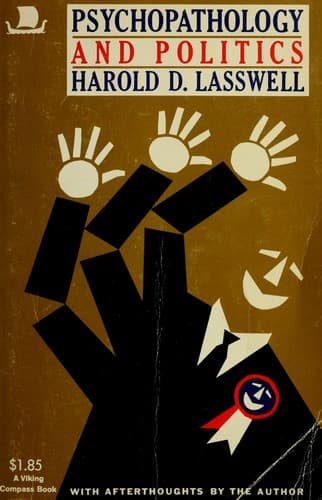
Psychopathology and politicsLasswell, Harold D. (Harold Dwight)
Science
Psychopathology and politics
Lasswell, Harold D. (Harold Dwight)
Personality and politics; Political science; Psychoanalysis; Psychology, Pathological
The chief possible virtue of tendency conceptions is in introducing
some sort of order in complex phenomena. If the observer tries to
enumerate all the body movements, all the electronic gyrations, all
the nuances of social adjustment which are thinkable in a given
constellation of personality events, he is likely to become lost
in aimless classification, and to prove barren in the invention of
procedures which are calculated to elicit particular aspects of the
whole which may be of high predictive value. The human mind is able to
operate with a very small number of categories with which to introduce
order into events, particularly when these are, for the most part,
still defined qualitatively. Clarity of thought demands economy in the
orienting frames of thought.
How a tendency simplification may lead to fruitful research for
predictively valuable particulars is shown in the case of Freud, in
contrast to Janet. Janet made remarkably clear classifications of
the psychopathological facts as he saw them, and although his terms
and categories were abundant, his work was comparatively sterile of
novel procedures for the modification of human personalities. Even
his classificatory pursuits were hampered by his little-criticized
assumptions. His notion that dreams were passing confusions which
were traceable to diminished psychological tension in sleep deprived
dream material of all significance as classifiable data, and he almost
completely ignored it. Freud, who tended to operate with a few bold
tendency simplifications, brought into the range of observation whole
categories of data which have high predictive value.
When tendency simplifications are used until vast numbers of instances
accumulate of their supposed operation, “subtendencies” (such as
the variations of the manifestations of the Oedipus constellation)
multiply apace until the problems of rendering one tendency consistent
with the expressions of another one carry scientific speculations
into the logical molds of legalism and dogmatic theology. If the
subtendencies are not modified, and long lists of special tendencies
are added, terminological difficulties likewise arise in applying the
unwieldy list. The long inventories of supposed instincts are less at
fault because they imply an unwarranted assurance about the innate
propensities of man than because they are “too numerous to mention,”
and introduce confusion rather than orienting principles in the field
of study.
Although the prediction of one set of tangible reactions from another
is the aim of scientific formulation, this by no means implies, then,
that the reactive style of thinking is the one best calculated to guide
the attention of the thinker to the selection of the most fruitful
hypotheses (“if” predictions). Indeed, especially valuable results have
been secured in the personality field by the pattern of thinking which
views a cross-section of facts as an expression of a few tendencies.
Public-domain text, read in full here on John Shaqi.
Reviews
Reviews
No reviews yet
Be the first to share your thoughts on this work.
Elsewhere in the archive
Join the Discussion
Join the discussion
Sign in to leave a comment or review.
Sign InorCreate an account