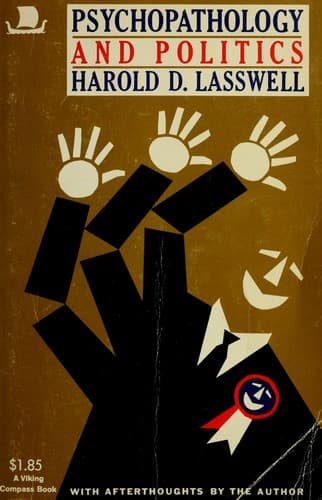
Psychopathology and politicsLasswell, Harold D. (Harold Dwight)
Science
Psychopathology and politics
Lasswell, Harold D. (Harold Dwight)
Personality and politics; Political science; Psychoanalysis; Psychology, Pathological
The comparisons which may be made among personalities on the basis of
the nature of the substitutive reactions which arise when they are
subjected to similar conditions may be illustrated on the gross level
by citing some “experiments” which society has tried. Mr. A is a member
of the city council in one of our large cities. On two occasions,
when he was defeated for re-election, he developed autistic reveries
to such an extent that he was confined in a sanitarium under the care
of a psychiatrist. Thus Mr. A met a deprivation in the sphere of his
orientation to social objects (political activity) by developing
exaggerated autistic reveries (depressive preoccupations). The case of
A may be thrown up against that of Mr. B. When Mr. B lost out in his
campaign for re-election to the legislature, he began to worry about
his health, and although the physicians could find no adequate physical
basis for his trouble, he developed a host of gastro-intestinal
disturbances which incapacitated him from regular professional
life. His substitutive reaction was somatic. Another man, a Mr. C,
was defeated and spent most of his time writing a subsequently
well-recognized book on political theory. His substitutive reaction
was in the sphere of consecutive, theoretical, adjustive thinking.
It will be remembered that one of our driving administrators, J, had
his administrative duties curtailed and immediately took the wife of
another for his mistress showing that his object orientation in the
world of affairs was a substitute for his object orientation in the
sexual field.
From this point of view, we are able to examine the relative function
which political activities and preoccupations play in the personality
integration of the individual. For one it is an alternative to mental
disorder, for another it is an alternative to physical disease, for
another an alternative to aggressive sexuality.
Now it is of interest and importance to observe that the study of
the life-histories of these men showed that their mode of meeting
the world had become organized rather early. The man who developed
somatic symptoms had shown a physical upset after losing a contest for
the presidency of his class in college, and also in adolescent and
preadolescent deprivation situations. Alexander traced the basis for
the personality splitting in J to very early childhood.
Public-domain text, read in full here on John Shaqi.
Reviews
Reviews
No reviews yet
Be the first to share your thoughts on this work.
Elsewhere in the archive
Join the Discussion
Join the discussion
Sign in to leave a comment or review.
Sign InorCreate an account