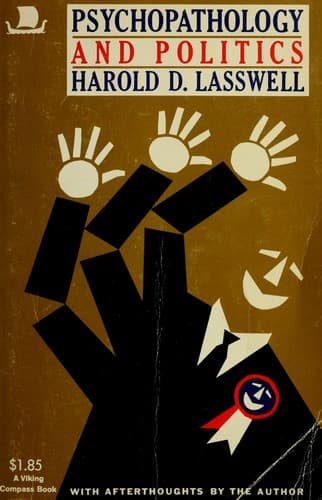
Psychopathology and politicsLasswell, Harold D. (Harold Dwight)
Science
Psychopathology and politics
Lasswell, Harold D. (Harold Dwight)
Personality and politics; Political science; Psychoanalysis; Psychology, Pathological
These objective categories and recording practices can be extended
to the study of behavior wherever dominating and submissive behavior
is found. The gap between the studies of children and the study of
personalities in complicated adult political situations can be filled
in with the idea of finding reliable criteria of the stability of
political reactions. Some early studies have been made which suggest
that types of dominating behavior are isolable at very early ages.
Charlotte Bühler detected children who dominated through pressure of
activity, despotic behavior, and “leadership” behavior. Her monograph
reproduces photographic illustrations of what she means by the terms
employed.[67] An outgrowth of her work is the experimental study by
Marjorie Walker at the Minneapolis Institute of Child Welfare (under
direction of Anderson and Goodenough). An observational study by
Mildred Parten at the same place showed that in uncontrolled play
activities the dominating or submissive rôles might be strikingly
monopolized by individual children.[68] By methods which are less
objective but much better than simple impressionism, there have been
a number of “political types” observed in later development. Karl
Reininger kept a careful record of the behavior of his pre-puberty
schoolboys, and brought out very clearly the functional distinction
between the “leader” and the “specialist.” The specialist might
temporarily guide the group in some activity for which he was
particularly competent, but the leader kept him within limits and
reassumed the direction as soon as the special activity was over.
Reininger has many shrewd observations to offer about the bearing of
what he saw on the whole range of social psychological theory, and
his monograph is a beautiful example of how a circumscribed empirical
study can be given meaning and distinction against a broad theoretical
background.[69] Hildegard Hetzer watched the spontaneous groupings
of children in play groups, and shrewdly distinguished organizers,
specialists, and social leaders from one another.[70]
At a still later level is the study which Viktor Winkler-Hermaden
made of the psychology of youth-movement leaders. These leaders are
recruited from youths who are not much ahead of their groups in age,
and in a well-balanced and penetrating chapter he contrasted the
“ruler,” “teacher,” and “apostle.”[71]
Public-domain text, read in full here on John Shaqi.
Reviews
Reviews
No reviews yet
Be the first to share your thoughts on this work.
Elsewhere in the archive
Join the Discussion
Join the discussion
Sign in to leave a comment or review.
Sign InorCreate an account