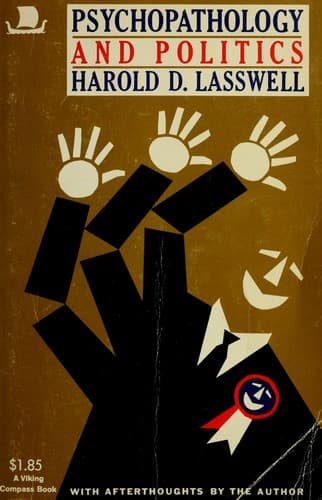
Psychopathology and politicsLasswell, Harold D. (Harold Dwight)
Science
Psychopathology and politics
Lasswell, Harold D. (Harold Dwight)
Personality and politics; Political science; Psychoanalysis; Psychology, Pathological
The view so far proposed rests upon a frank acceptance of social
“parallelism.”[78] Hans Kelsen has subjected the theories of
parallelism of psychological states (common emotion and the like) to a
sharp, and in many ways devastating, criticism. He says that “common
emotion, common volition and common idea can never mean anything more
than a description of the coincidence in consciousness of a number of
individuals.” But
if one really wished to consider the state as consisting of a
community of consciousness such as this, and as a matter of
fact, such a realistic, empirical psychological meaning is often
attributed to what is called the collective will or the collective
interest of the state, then, in order to avoid inadmissible
fictions, one would have only to be consistent enough really to
consider the state as formed only by the contents of those whose
consciousness had shown the necessary agreement. One would be
bound to realize that community of will, feeling or thought, as
a psychological group manifestation, fluctuates tremendously at
different times and places. In the ocean of psychic happenings,
such communities may rise like waves in the sea and after a brief
space be lost again in an ever-changing ebb and flow.[79]
In this keen dialectic Kelsen has been led astray by a failure to
recognize the time dimension of the events referred to by such a
concept as the state. Subjective facts are located in time in relation
to one another when viewed from the standpoint of any observer. The
concept of the state involves similar events in relation to one
another within a duration. The concept of the state includes this
idea of a temporal frame, and can best be grasped as a relational
system (a manifold) in which a certain frequency of subjective events
is maintained. Thus the state is not abolished when some individuals
sleep or occupy themselves with the banalities of existence, unless
the state is defined with reference to a duration of a few seconds
or hours or days. But there is no reason whatever for choosing such a
transitory frame of reference. It is just as valid to use a year as a
minute, or a decade as a year, for the time dimension. Thus the state
can be treated in what Kelsen speaks of as an “empirical psychological”
sense. It is a durable empirical fact just so long as a certain
frequency of subjective events occurs. If Kelsen agrees that contents
of consciousness are “empirical,” he is bound to see them in a world
of duration, and he has no authority to prescribe that the state must
refer to subjective events as a “knife-edge instant.”
The state, then, is a time-space manifold of similar subjective events.
Kelsen is incorrect in alleging that the acceptance of the parallelism
of psychological phenomena as a fundamental fact destroys the state as
a permanent institution.
Public-domain text, read in full here on John Shaqi.
Reviews
Reviews
No reviews yet
Be the first to share your thoughts on this work.
Elsewhere in the archive
Join the Discussion
Join the discussion
Sign in to leave a comment or review.
Sign InorCreate an account