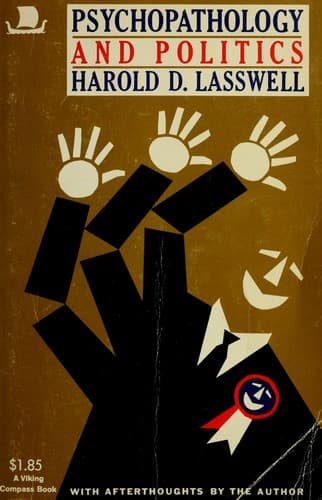
Psychopathology and politicsLasswell, Harold D. (Harold Dwight)
Science
Psychopathology and politics
Lasswell, Harold D. (Harold Dwight)
Personality and politics; Political science; Psychoanalysis; Psychology, Pathological
Mere parallelism of psychological events does not give us the state,
for a distinguishing type of subjective event must be selected if
we are to characterize the state, the family, and other social
groups. Kelsen is entirely correct in criticizing those theories
of the state which invoke parallelism but neglect to specify the
particular “contents of consciousness,” “since not every and any group
manifestations formed upon the parallelism of psychic processes is able
to constitute that community.”
That subjective event which is the unique mark of the state is the
recognition that one belongs to a community with a system of paramount
claims and expectations. This recognition of belonging does not
necessarily imply an indorsement of this state of things. The essence
of the state is this recognition, and the individual may indorse or
deplore the fact without abolishing it. One need not be sentimentally
bound to the order; it is enough if the order is noted.
This unique experience is never found unassociated with other
subjective events. The recognition is usually amplified by pride in
belonging to the state, and by a determination to enforce the order
upon one’s self and others. One’s recognition of the order is usually
accompanied by an idealization of one’s participation in it, by an
idealization of the order itself, and by a condemnation of deviations
from it. All this is frequently expressed as the “sense of justice”
which is the foundation of certain theories of law and the state.
The subjective event which marks the state is usually manifested in
various “externals.” Thus the use of coercion is well-nigh universal.
The externals may be broadened to include behavior which may be treated
as a substitute for coercion. Ordering and obeying relationships which
function in a coercive crisis may continue when peace comes. There
may be an apparent “elaboration backward” of processes antecedent to
coercion in foreign and domestic affairs, and this may obviate a resort
to the _ultima ratio_. The regulation of the use of coercion, and the
maintenance of a certain degree of mobilization during non-crisis
periods, devolves upon “leaders,” who may preside over initiations,
goods distribution, and general ceremonials. The process by which
“heads” are selected may involve electoral colleges, elections, and
agitations.
It is worth observing that in the description of political processes
terms are employed which often carry no “subjective” connotations on
their face. But in fact every term unavoidably carries subjective
implications, and if these be ignored, there is danger that social
theory will hypostatize “patterns” or “traditions” as extra-subjective
entities, endowed with distinctive energies and amenable to special
laws.
Public-domain text, read in full here on John Shaqi.
Reviews
Reviews
No reviews yet
Be the first to share your thoughts on this work.
Elsewhere in the archive
Join the Discussion
Join the discussion
Sign in to leave a comment or review.
Sign InorCreate an account