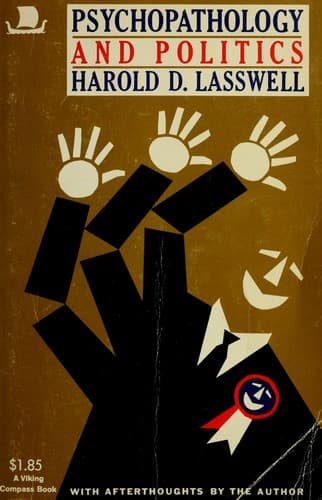
Psychopathology and politicsLasswell, Harold D. (Harold Dwight)
Science
Psychopathology and politics
Lasswell, Harold D. (Harold Dwight)
Personality and politics; Political science; Psychoanalysis; Psychology, Pathological
There is more in common between the student of culture, and
especially of alien culture, and the student of the individual by
prolonged-interview methods than might appear at first sight. The
ethnologist confronting the manifestations of an alien culture and
the psychopathologist confronting the alien manifestations of the
unconscious secure unique training in their research for meanings in
details which escape the attention of the naïve man. Both form their
idea of the subjective events from a multitude of signs, which may
be spread over months of intimacy, and both are somewhat inclined to
disparage the search for simple external facts which can be relied upon
to indicate a specific subjective content.
The psychopathologist possesses the most elaborate known means of
exploring the manifold subjective events which may be associated
with external movements. Besides the conscious subjective experience
there is a rich unconscious life which he is especially proficient
in exposing. Thus our movements are not alone the outcome of simple
conscious processes; they are said to be “overdetermined” by a variety
of factors.
This concept of overdetermination is not unknown to popular common
sense. We know that John B is proud of being an American, and that he
wants to fight for his country; we comment slyly that John B’s best
girl likes the uniform, and this is one reason why he volunteers.
And more than that. We know that action is not always the outcome of
experiences that point in the same direction. We may know that John B.
is anxious to stay on the job a month longer and to get a promotion,
and that going into the army at a given moment means sacrifice. Thus
his mind is partly divided against itself. What psychopathological
methods do is to disclose yet wider vistas, and to expose the operation
of factors which cannot be readily seen. Thus a deep longing for death
may be a contributing factor to heroism.
The psychopathological approach is embarrassing less in the specific
content of its revelations than in the wealth of meaning which it
discovers behind what is at first glance but a simple pattern. The
rôle, of a particular subjective experience and of a movement cannot
be fully appraised apart from the total context at which it functions,
and this method discloses a wider context than common sense is aware of.
Public-domain text, read in full here on John Shaqi.
Reviews
Reviews
No reviews yet
Be the first to share your thoughts on this work.
Elsewhere in the archive
Join the Discussion
Join the discussion
Sign in to leave a comment or review.
Sign InorCreate an account